

What "self-aligning" means, and why it matters on a vessel
On a conventional rotator the roller centre distance is fixed once set, and the two rollers in each unit are mounted parallel. That works while the shell is perfectly round. Real shells are not: rolling tolerance, longitudinal seam shrinkage and out-of-roundness all mean the contact point moves as the vessel turns. On a fixed rotator the result is a shell that runs slightly out of true, a drive that alternately loads and unloads, and a welding arc whose height changes once per revolution.
A self-aligning rotator — the SAR series — solves it by mounting the two rollers on pivoting frames inside each unit. The pair rotates as a set, so each unit conforms to the shell surface it is touching. The shell stays concentric, the drive load stays even and the seam height stays constant, which is exactly the condition a submerged-arc or MIG girth seam needs.
Self-aligning versus conventional
| Factor | Self-aligning (SAR) | Conventional (WR) |
|---|---|---|
| Roller mounting | Pivoting frames — each pair conforms to the shell | Fixed parallel rollers, centre distance adjusted in steps |
| Out-of-round shells | Tolerated — contact stays even | Produces runout and uneven drive load |
| Diameter changes | Handled without re-shimming | Requires re-setting the centre distance |
| Setup time | Short — set once for a family of diameters | Longer, especially with mixed shell sizes |
| Relative cost | Higher | Lower |
| Best application | Pressure vessels, columns, wind towers, mixed-diameter shops | Repeat work on consistent diameters, lighter sections |
The cost difference pays back quickly in shops that run a mix of diameters. A conventional set re-set three times a shift for different shell sizes costs more in crane time and fitter hours than the self-aligning premium, and it never recovers the weld quality lost to runout.
Petrochemical and pressure vessel duty
Petrochemical work puts four demands on a rotator that general fabrication does not:
- Seam quality under a welding procedure specification. Girth seams on pressure vessels are welded to a qualified WPS with a specified heat input. That is only achievable if the surface speed is constant and the joint stays at the same height under the torch. Runout on the rollers translates directly into heat input variation.
- Heavy wall sections. Wall thickness on process vessels and columns runs well above general fabrication, so the rotator has to hold a high, steady torque at low rotational speed. Low-speed torque capability, not maximum rotational speed, is the specification that matters.
- Long shells with multiple courses. A column or tower is welded course by course and grows in length. Axial drift accumulates over a long shell, so thrust rollers and a locating arrangement have to be part of the setup, not an afterthought.
- Cladding and overlay work. Where a vessel is internally clad or hardfaced, the rotator also carries the overlay passes, which means stable low-speed rotation for hours rather than minutes.
Capacity options in the SAR range
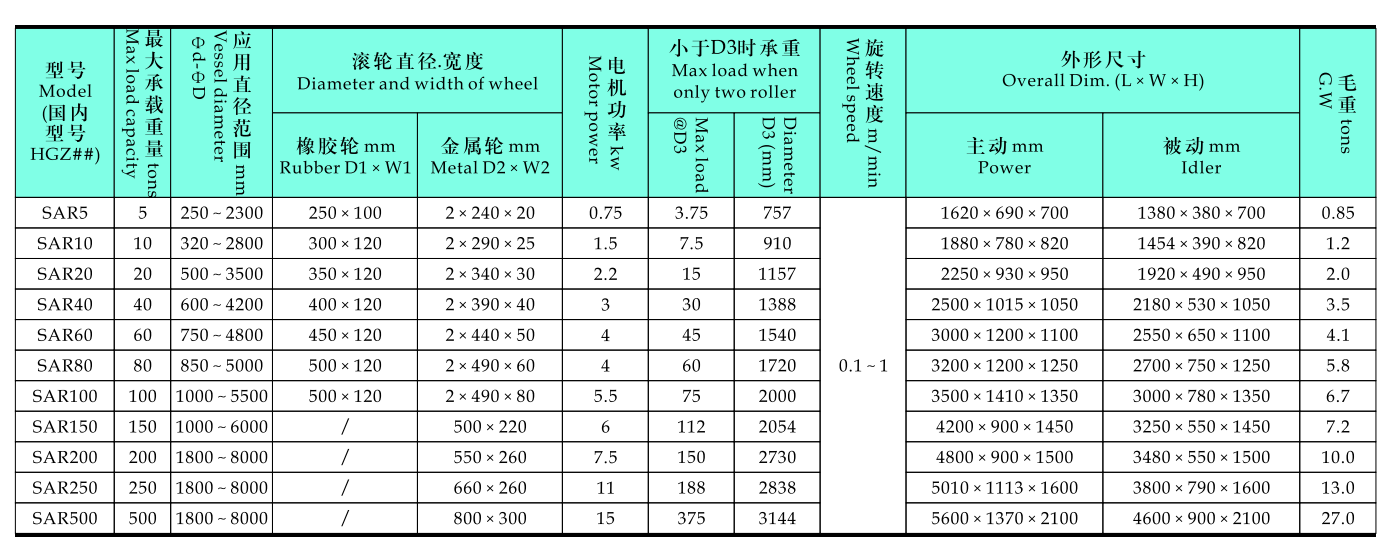
The SAR family spans the same 5 t to 500 t capacity band as the DESAN turning roll programme, with polyurethane or steel rollers and VFD drive. Higher-capacity sets use a powered drive unit with an idler unit; very large sets may use two powered units for torque and traction. Roller diameter scales with capacity, and roller material is selected against the shell surface — polyurethane for polished or clad surfaces, steel for heavy carbon steel with mill scale.
Two specification points are routinely missed. The first is traction: on a large diameter shell the friction drive has to move a lot of mass through a small contact patch, and polyurethane on a wet or oily shell will slip. The second is earthing: welding return current must pass through a brush or slip ring, never through the roller bearings.
Specifying an SAR set
To configure a self-aligning rotator set we need: vessel diameter range, maximum weight, shell length and number of courses, wall thickness and material, the welding processes used (SAW girth seams, MIG cladding, TIG root), the applicable WPS heat input limits, and the shop power supply. For pressure vessel work we also need to know whether the machine will be subject to any third-party inspection requirement, so that documentation can be prepared with the quotation.
Minimum order quantity is 1 set. Standard sets ship in 30–50 days after deposit; special configurations are scheduled in the technical proposal. Payment terms are T/T; trade terms are FOB, FCA or CIF. Core ranges are CE compliant and supplied against a certificate of compliance.
Turning rolls are supplied under the DESAN brand, positioners and manipulators under BIQEE, combination welding machines under ZAULUX — all quoted and contracted by DESAN ELECTRIC LTD, serving 1,000+ customers in 20+ countries for over 20 years, with welding engineering experience since 1997. For explosion-protected applications in paint and coating shops, see the SAR80 explosion-proof rotator; for conventional fixed-roller rotators, see the WR turning roll range.