

Why a paint shop needs a different rotator
Rotating a vessel in a paint or coating booth looks like the same job as rotating it for welding, but the environment changes the equipment requirements completely. Inside a booth, the atmosphere contains solvent vapour at a concentration that can sit within the flammable range, and the machine's own motor, brake, terminal box and cable entries are all potential ignition sources. A standard rotator with an open drip-proof motor and a ventilated terminal box is not acceptable in that atmosphere.
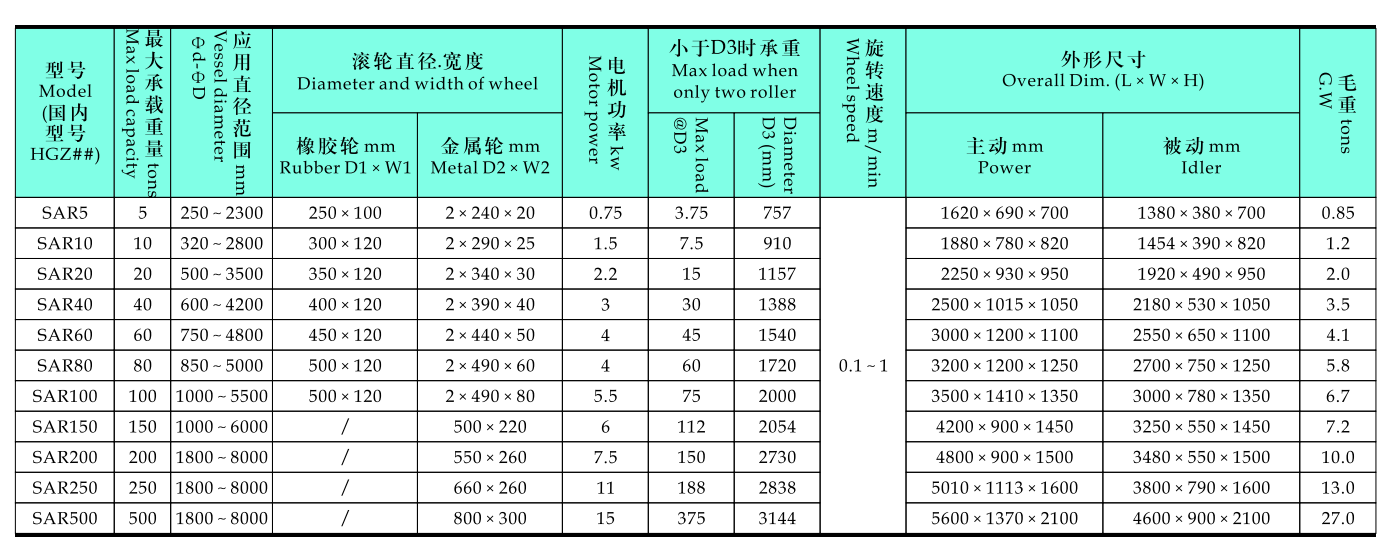
The SAR80 is the explosion-proof variant of the self-aligning rotator family, built for paint shops, coating lines and solvent-containing environments: a rotator whose electrical equipment is enclosed against the flammable atmosphere and whose mechanical parts are arranged to avoid sparks and static accumulation.
What "explosion proof" has to cover
Explosion protection on a rotating machine is not one feature, it is a set of them operating together. On a rotator set, the relevant items are:
| Ignition source | Protection measure on the rotator |
|---|---|
| Motor windings and rotor | Flameproof or increased-safety motor enclosure with the appropriate gas group and temperature class for the zone |
| Terminal box and cable entries | Sealed, certified enclosure and certified cable glands; no unsealed knock-outs |
| Control panel and VFD | Panel located outside the hazardous zone, or itself certified for it |
| Static electricity on the shell and rollers | Continuous bonding and a dedicated earth connection through a proper slip ring or brush — not through bearings |
| Mechanical friction and impact | Non-sparking contact surfaces, guards that prevent metal-to-metal contact, and avoidance of light alloys at contact points |
| Surface temperature | Temperature class compliance — the machine's hottest surface must stay below the auto-ignition temperature of the solvent in use |
Each of these depends on the zone classification of the booth and the solvent in use, so the correct approach is to specify the machine against the customer's hazardous area classification — zone, gas group and temperature class — rather than to buy a nominally "explosion-proof" machine and hope it matches.
The grounding point deserves its own paragraph
Static is the ignition source most often overlooked in coating shops. A vessel being rotated carries charge, and the roller contact does not reliably dissipate it. Without a dedicated earthing arrangement — a brush or slip ring bonded to the workpiece and to the machine frame, with the frame itself earthed to the building's protective system — charge accumulates and can discharge as a spark. In a booth with solvent vapour present, that is the failure mode that destroys the shop. It is also the cheapest item on the machine to get right and the most expensive one to get wrong.
Paint, coating and surface finishing applications
- Paint booths — rotating vessels and tanks for spray application so the operator reaches the full circumference without accessing the inside of the booth.
- Powder coating lines — where the atmosphere is less hazardous but conductive dust and static are present.
- Solvent and lacquer workshops — enclosure coating, internal lining and protective finishes.
- Rubber and elastomer lining — rotation during cure in an atmosphere that may carry solvent.
- Fuel and chemical tank preparation — where residual product vapour may be present even after cleaning.
Practical points when the machine goes into a booth
Three things about the installation decide whether the protection actually holds:
- Cable routing. Certified glands are worthless if the cable is later re-terminated on site with a standard gland. The installation instructions have to travel with the machine and be followed at commissioning.
- Panel location. The VFD and control panel are usually the largest electrical items on the set. Placing them outside the classified zone is normally the cheapest compliant solution — running the motor cable from outside the booth costs less than certifying the panel.
- Inspection regime. Explosion-protected equipment requires periodic inspection of enclosures, glands and earth bonding. That is a maintenance commitment, not a one-off purchase.
Specifying a SAR80
To quote an explosion-protected rotator we need: the hazardous area classification of the installation (zone, gas group, temperature class), the solvent or coating material in use and its auto-ignition temperature, vessel diameter range and weight, the rotation speed range required by the coating process, whether the machine sits inside or outside the booth, and the applicable national regulation for the site. Where third-party certification or notified-body assessment of the assembly is required, that has to be identified at enquiry stage so the documentation package can be built with the quotation.
Minimum order quantity is 1 set. Standard configurations ship in 30–50 days after deposit; special protection arrangements are scheduled in the technical proposal. Payment terms are T/T; trade terms are FOB, FCA or CIF. Equipment is supplied against a certificate of compliance, with the explosion-protection documentation matched to the classification stated at order.
Turning rolls are supplied under the DESAN brand, positioners and manipulators under BIQEE, and combination welding machines under ZAULUX — all quoted, contracted and shipped by DESAN ELECTRIC LTD. The company has supplied 1,000+ customers in 20+ countries over 20+ years, with welding and positioning engineering experience dating from 1997. For standard vessel welding, see the SAR self-aligning rotator range or the WR conventional turning rolls.