

A longitudinal seam is a straight line, and that changes everything
A girth seam is welded by turning the workpiece under a fixed torch. A longitudinal seam cannot be: the joint runs along the length of the shell, so either the torch travels or the workpiece does — and the workpiece has to be held flat and clamped while it happens. That is a different machine, and it is why shell shops own a longitudinal seam welder alongside their rotators.
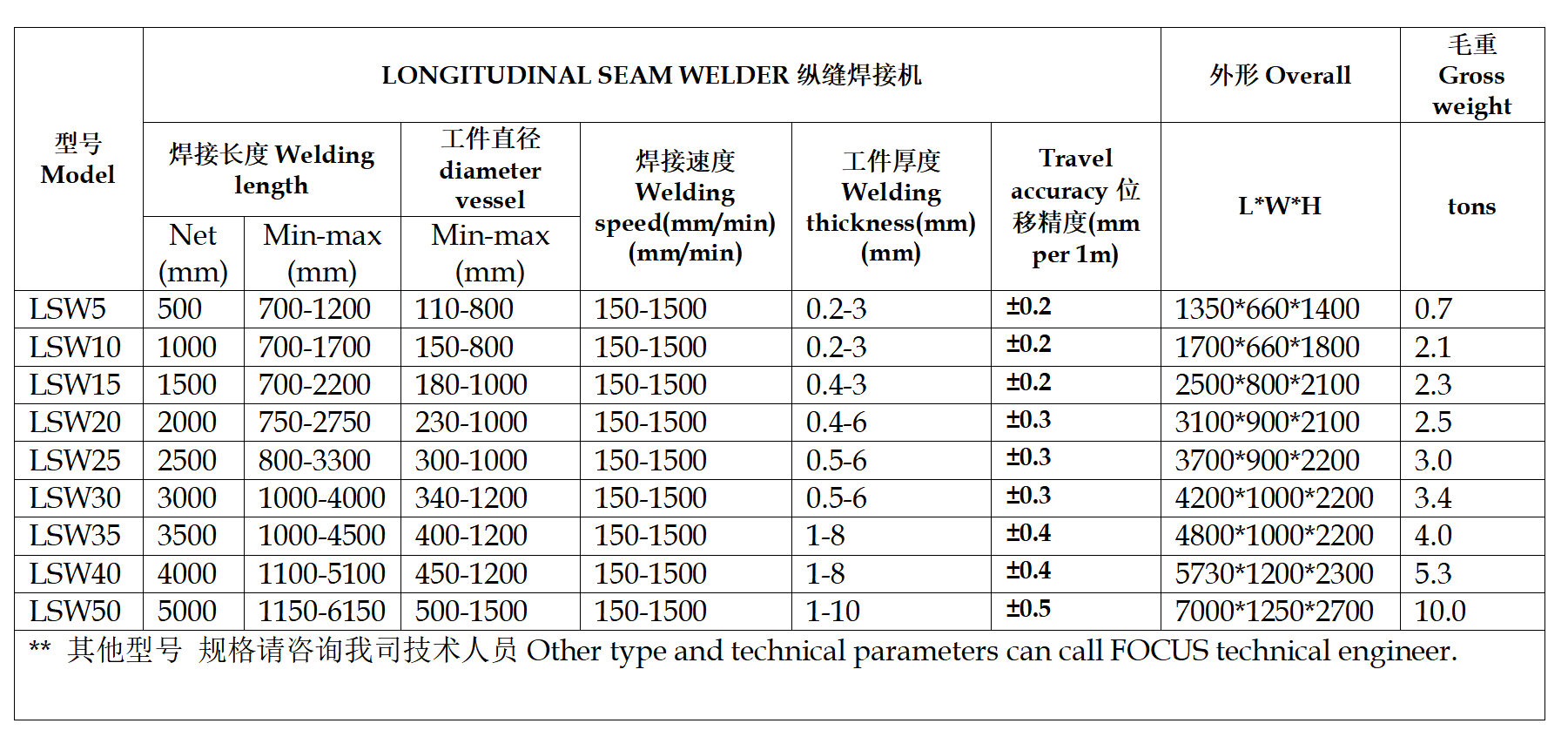
The LSM range is a dedicated longitudinal seam machine: a bed that clamps the shell or panel flat along the joint, a carriage that travels the length of the seam, and a welding head that holds the correct angle and stand-off from one end to the other.
The three things a longitudinal seam machine must get right
1. Clamping along the whole seam
Welding shrinks, and a longitudinal seam pulls the shell as it cools. If the shell is only clamped at its ends, the seam bows in the middle and the finished shell is not round. The clamp has to hold the joint along its full length — hydraulic clamps or a series of pneumatic rams on a rigid beam — and it has to hold the two edges at the correct gap, not just bring them together.
This is the difference between a straight seam and one that is welded and then straightened. On a 6 m shell, the accumulated bow from an unclamped seam is measured in centimetres.
2. Backing that controls penetration
A full-penetration longitudinal seam is normally welded against a copper backing bar that pulls heat out and forms the root bead. The backing has to be pressed tight against the underside — a gap between backing and plate produces a root that is uneven or missing. Flux backing or ceramic tape are used where copper cannot be applied, and each choice changes the welding parameters.
3. Carriage stability over the length
The head travels the full seam length, so any deviation in the carriage path becomes a deviation in the weld. Rails have to be straight and level relative to the bed, and the carriage drive has to hold a constant speed — a drive that surges changes heat input locally and leaves visible banding.
Where it sits in a shell production sequence
| Step | Operation | Machine |
|---|---|---|
| 1 | Cut and bevel the plate | CNC cutting table plus edge beveling or milling |
| 2 | Roll the plate to diameter | Plate rolling machine |
| 3 | Weld the longitudinal seam | Longitudinal seam welder |
| 4 | Re-roll to round after seaming | Plate rolling machine |
| 5 | Fit up courses and weld girth seams | Turning rolls or fit-up rotator plus column and boom |
Step 4 is the one shops skip. A shell that comes off the seam welder is not round — the seam has pulled it — and re-rolling after seaming is what restores the diameter before the course is fitted up. Skipping it transfers all the ovality into the girth seam, where it becomes a root gap problem.
Processes and configurations
Longitudinal seam machines are built around Submerged arc for carbon and low-alloy shells, MIG/MAG for thinner material and for stainless where flux handling is undesirable, and TIG for thin-wall and high-integrity work. Options that matter in practice:
- Flux recovery — on a 6 m SAW seam the flux bed is continuous and the consumption is significant.
- Oscillation and multi-run programming — a thick shell needs several passes; the machine stores and repeats the sequence.
- Weld camera or remote monitoring — the operator is normally at the head, but on long seams a remote display helps.
- Second clamping station — one seam welding while the next shell is loaded.
Applications
- Pressure vessels and boilers — shell courses before rolling or after, depending on the shop's sequence.
- Storage tanks and silos — long longitudinal seams on shell plate.
- Panels and boxes — fabricated panels where a straight seam has to be welded flat.
- Engineering machinery — boom and mast sections fabricated from folded or rolled plate.
Specifying an LSM
We need: shell or panel thickness range, seam length, minimum and maximum diameter or flat panel size, material, welding process and number of passes, required clamping and backing arrangement, cycle time per seam, and the shop layout including how the shell is loaded onto the bed.
Minimum order quantity is 1 set. Standard machines ship in 30–50 days after deposit; custom bed lengths and clamping packages are scheduled in the technical proposal. Payment terms are T/T; trade terms are FOB, FCA or CIF. Core ranges are CE compliant and supplied against a certificate of compliance.
Special-purpose welding machines are supplied by DESAN ELECTRIC LTD under the DESAN, BIQEE and ZAULUX brands. The company has served 1,000+ customers in 20+ countries over 20+ years with welding engineering experience since 1997. For girth seams after seaming, see self-aligning rotators and the column and boom manipulator range.