

What a column and boom manipulator is for
A column-and-boom manipulator is a mast with a horizontal arm that carries a welding head over or inside a workpiece. It exists to solve a positioning problem that positioners and rotators cannot: the torch has to be at a precise height and stand-off along a seam, not just at the right angle.
On a vessel, the workpiece turns and the weld stays at one place — so a fixed head is enough if the height happens to be right. On a longitudinal seam, a stiffener, an internal weld or a nozzle, the head has to travel. A manipulator gives that travel in two axes (boom in/out, column up/down) with a rigid structure, so the arc length does not change as the head moves.
Why rigidity is the whole specification
A welding head that vibrates or deflects produces a bead whose width and penetration change along its length. On a 6 m boom extended fully, the deflection under the weight of the head, the cross-slide and the welding leads is the design problem — not the motor. Three things control it:
- Section depth of the boom. Booms are usually a welded box section, deeper than a commercial tube, because deflection scales with the cube of depth. A boom that looks generous in a photograph is usually a box, not a pipe.
- Counterweight and balance. An extended boom with no counterweight applies a large moment to the column. Counterbalanced booms keep the column load roughly constant through the stroke.
- Column base and foundation. The stiffest boom in the world deflects if the column base is bolted to a floor slab that flexes. Base plates are grouted and bolted, and the foundation is part of the machine.
Configurations
| Configuration | Motion | Where it fits |
|---|---|---|
| Fixed column, fixed boom | Boom in/out, column up/down | One station, one workpiece size — cheapest and stiffest |
| Fixed column, rotating boom | Plus 360° boom slew | Several stations around one column: two vessels, or a vessel and a fit-up bed |
| Travelling column | Plus travel along a rail | Long workpieces — tower sections, long shells, beam lines |
| Portal / gantry frame | Two columns, bridge between | Wide workpieces where a single cantilever cannot reach without excessive deflection |
| Cross-slide on the boom end | Additional short traverse | Fine seam positioning and oscillation without moving the boom |
The travelling-column version is the one most often under-specified. A rail-mounted column needs the rail to be straight and level over its full length; a 20 m rail with 2 mm of settlement produces a weld that climbs and dives by 2 mm, which on a TIG root is the difference between penetration and lack of fusion.
Matching the manipulator to the welding process
The process decides what the manipulator needs to carry:
- Submerged arc — head, flux hopper, flux recovery, wire feed, and a heavy cable bundle. SAW heads are bulky and the manipulator must carry them at the far end of the boom without droop. Flux recovery is usually mounted on the boom, which adds weight exactly where it hurts most.
- MIG/MAG — lighter head but a stiffer cable bundle; the wire feeder is best mounted on the boom to keep the torch lead short.
- TIG — lightest head, but cold wire feed and a trailing shield often added, plus the need for very stable travel because TIG is far more sensitive to arc length variation.
- Plasma — heavy torch, high gas flow, and a water-cooled lead; the manipulator carries more services than the head weight suggests.
What to specify before asking for a price
- Workpiece size range: diameter, length, and where the seams sit relative to the floor.
- Whether the head must reach inside the workpiece (internal welding), and the minimum internal diameter.
- Required boom reach and column stroke, measured from the actual joint positions — not from the machine envelope.
- Welding process and the head package weight.
- How many stations the machine must serve, and whether it travels between them.
- Whether a cross-slide, oscillator, seam tracking or weld camera is required.
Technical data: WM manipulator range
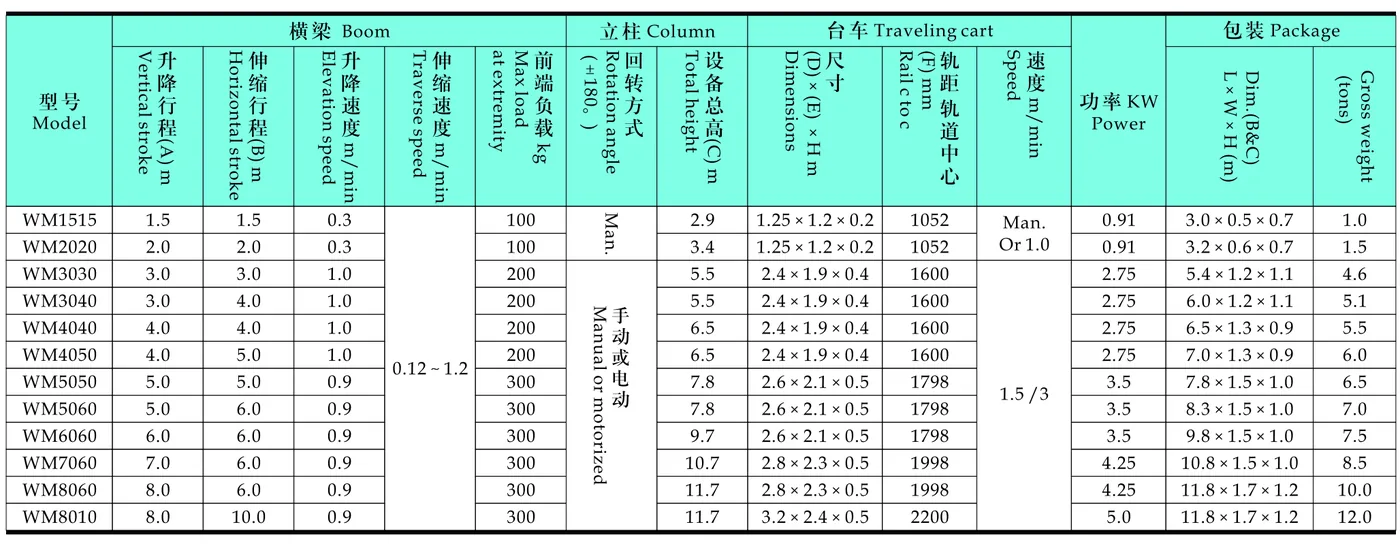
The WM range is sized by boom stroke, and the model number follows it — WM4040 is a 4 m boom with 4 m column elevation, WM5050 is 5 m, WM6060 is 6 m. Each is supplied as a complete welding centre: column-and-boom, seam tracker, submerged-arc power source, flux handling and a matched rotator.
| Model | Applicable vessel Ø | Boom travel stroke | Boom elevation stroke | Operator platform |
|---|---|---|---|---|
| WM4040 | Φ630 – 4,000 mm | 4,000 mm | 4,000 mm | Not fitted |
| WM5050 | Φ630 – 5,000 mm | 5,000 mm | 5,000 mm | Fitted |
| WM6060 | Φ630 – 6,000 mm | 6,000 mm | 6,000 mm | Fitted |
Common to the range: boom travel 100 – 2,000 mm/min on inverter drive, boom elevation at 1,050 mm/min, column revolving ±180° on a heavy-duty cross-roll bearing, trolley travel 0.12 – 1.20 m/min, and boom droop of 2 mm/m along horizontal travel.
Why the 2 mm/m droop figure matters
Every cantilever drops, and 2 mm per metre of extension is the honest number for this class. On a WM6060 at full extension the head is about 12 mm lower than at the column. That is entirely manageable — provided you know it. The failure mode is an operator setting stand-off at the column end and then finding the arc has drifted 12 mm closer at the far end of a seam. The practical responses are to set the cross-slide at the mid-point of travel, or to fit the seam tracker, which corrects height and lateral position continuously and makes the static droop irrelevant.
The complete welding centre
A WM manipulator is rarely bought as a bare structure. The standard package is:
| Item | Role |
|---|---|
| Column-boom (movable and revolving) | Carries and positions the welding head |
| KB-10 seam tracker (optional) | Detection range 100 mm, speed 200 mm/min, accuracy ±0.3 mm, 100 kg load, AC 220 V — holds two guns in parallel |
| DC-1000 submerged-arc system (optional) | 1,000 A at 100% duty, 200–1,000 A range, wire 3–6 mm, 15–75 m/h — with control box and wire feeder |
| FRU80 flux feeding and recovery | Recovery distance ≤16 m, recovery speed 12 kg/min |
| SAR20 welding rotator | 20 t, Φ500–3,500 mm, steel all-roller Φ350 × 120 mm, 1.5 kW rotation at 0.1–1 m/min, 0.75 kW trolley |
Specifying these together is not packaging convenience. A 1,000 A submerged-arc head on a 20 t rotator defines the thickest shell the combination can weld at a controlled heat input; add the machine to a separate spec sheet and nobody checks that the rotator can hold the surface speed the WPS needs.
Construction details
Column and boom are rectangular-section double-rail beams, welded, stress-relieved and machined — stress relief before machining is what stops a 6 m beam bending after it has been cut true. The saddle carries eight sets of control rollers, three per set in an eccentric adjustable mounting, contacting the rails on three sides; that arrangement is what keeps travel smooth at 100 mm/min instead of stick-slipping. Boom elevation runs through an A.C. braking motor, reducer, chain and sprocket with counterbalance, with a ratchet-type anti-drop unit on the column as the safeguard against chain failure.
Supply terms
Column and boom manipulators are configured per project against the workpiece list; the DESAN WM range covers boom reach and column stroke from 3 m to 12 m with SAW, MIG or TIG head packages. Minimum order quantity is 1 set. Standard machines ship in 30–50 days after deposit; multi-station and travelling configurations are scheduled in the technical proposal. Payment terms are T/T; trade terms are FOB, FCA or CIF. Core ranges are CE compliant and supplied against a certificate of compliance.
Manipulators are supplied under the BIQEE brand, turning rolls under DESAN and combination welding machines under ZAULUX, all quoted and contracted by DESAN ELECTRIC LTD, which has served 1,000+ customers in 20+ countries over 20+ years with welding engineering experience since 1997. For specific model configurations see the WM12 boom and column and the WM5050 welding boom column.