

WM12: a column and boom built for petrochemical fabrication
Petrochemical workshops weld vessels, columns, reactors and separator shells in a range that is large but repetitive — several diameters, a few wall thicknesses, seams in predictable places. The WM12 column-and-boom manipulator is configured for that pattern: a fixed or travelling column carrying a boom with a Submerged-arc head package, set up so the same machine serves both circumferential and longitudinal seams on the shell courses the shop actually builds.
Where a generic manipulator is bought on reach, a petrochemical manipulator is bought on three things: whether it can reach the internal seams, whether it can carry the SAW package without droop, and whether it survives a shop where the vessel is already hot from a preheat.
Internal seams: the requirement that changes the machine
On a vessel of any size, most of the welding is inside. A boom that only reaches over the top of the shell is a half solution: the external girth seam gets welded and the internal seam is still done by hand through a manhole.
The WM12 is normally specified with a boom slender enough to enter the shell through an open end, with a head that can be rotated to weld the internal circumferential seam looking outward. That is a different structural problem from external welding — the boom now works in a confined space, the head has to fit through the shell opening, and the operator cannot see the arc directly. Practical consequences:
- Boom section is limited by the shell opening. Internal welding caps the boom cross-section, which caps the reach and the head weight.
- Weld monitoring becomes essential. With the arc out of sight, a weld camera or at minimum a remote arc-voltage display is part of the package, not an accessory.
- Flux handling changes. Submerged arc inside a vessel needs flux feed and recovery arranged so the flux does not end up in the bottom of the shell.
Heat, spatter and the shop environment
Petrochemical work often involves preheat, which means the workpiece radiating heat at the manipulator for hours. Cable insulation, seals and the head's own cooling all have to tolerate that. The other shop realities — weld spatter on the column, dust from flux, and the occasional impact from a crane-slung shell — are dealt with by guarding the ways and keeping the drive and rack covered. A manipulator that is not built for this environment develops positioning backlash within a year.
Circumferential and longitudinal on one machine
Two seam types, one machine, and the difference is which axis does the work:
| Seam | Workpiece | Manipulator |
|---|---|---|
| Circumferential (girth) | Rotates on turning rolls at constant surface speed | Head held stationary at the top of the shell; boom and column set once |
| Longitudinal (shell seam) | Clamped flat on a bed or positioner | Boom traverses along the seam; column holds stand-off; cross-slide fine-tunes |
| Nozzle and branch | Fixed | Cross-slide and head rotation bring the torch to the joint |
| Internal girth | Rotates on rolls | Boom inside the shell, head looking outward |
The practical advantage of one machine over two dedicated stations is floor space and crane time. A vessel that has to be moved between an external welding station and an internal one is craned twice per course; a machine that does both requires the shell to be positioned once.
What to send with an enquiry
For a WM12 configuration the useful information is: vessel diameter and length range, wall thickness and material, whether internal welding is required and the minimum shell opening the boom must pass through, the welding process and whether flux recovery is needed, the number of stations the column must serve, and the shop floor layout with the crane capacity. Where the shop is building to a pressure equipment code, state the standard so the documentation package can be matched to it.
Supply terms
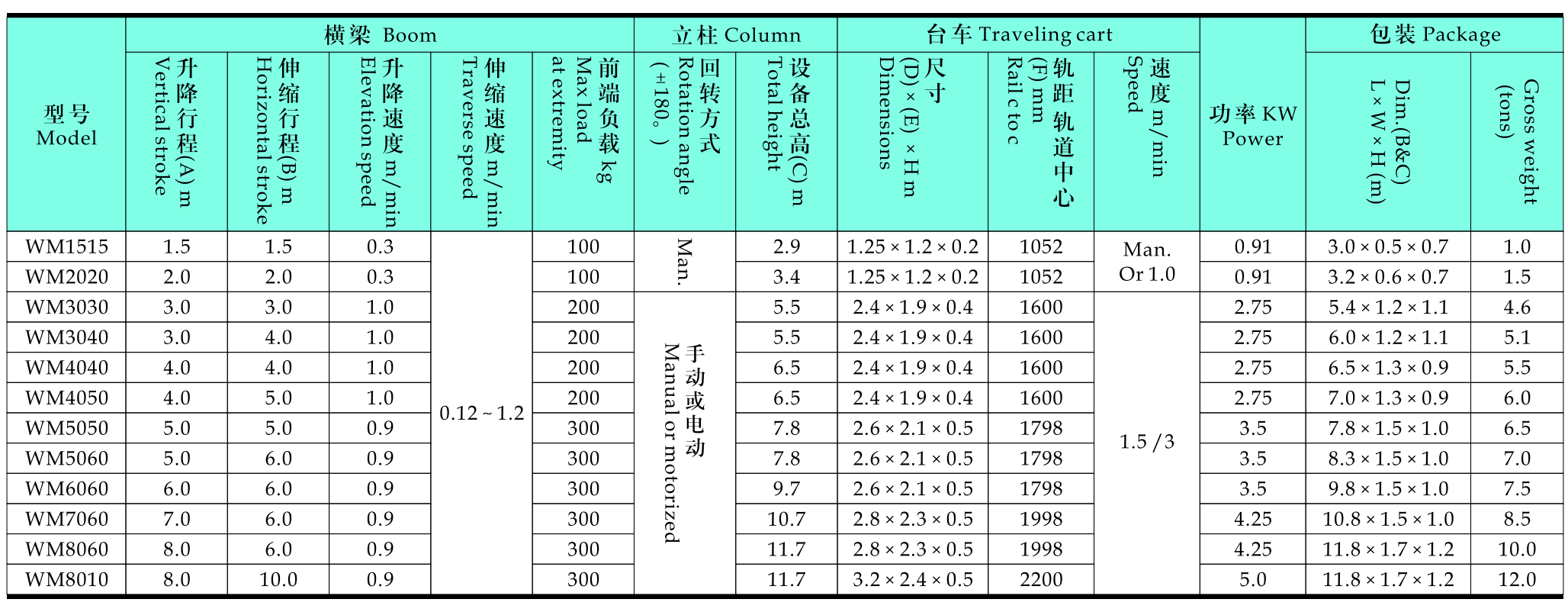
WM series manipulators cover boom reach and column stroke from 3 m to 12 m with SAW, MIG or TIG head packages. Minimum order quantity is 1 set. Standard machines ship in 30–50 days after deposit; project configurations are scheduled in the technical proposal. Payment terms are T/T; trade terms are FOB, FCA or CIF. Core ranges are CE compliant with a certificate of compliance supplied.
Manipulators are supplied under the BIQEE brand by DESAN ELECTRIC LTD, alongside DESAN turning rolls and ZAULUX combination welding machines. The company has served 1,000+ customers in 20+ countries over 20+ years with welding engineering experience since 1997. For the general selection criteria behind a column-and-boom machine, see welding boom selection; for the larger 5 m class machine, see WM5050.