

Large-component hardfacing: the problem is thermal, not mechanical
Hardfacing a two-tonne roll or a 400 mm shaft is not difficult because the deposit is hard to place. It is difficult because a large mass does not heat evenly, does not cool evenly, and carries the residual stress of every layer that has already been deposited. On small parts you can outrun the thermal problem; on large parts you cannot.
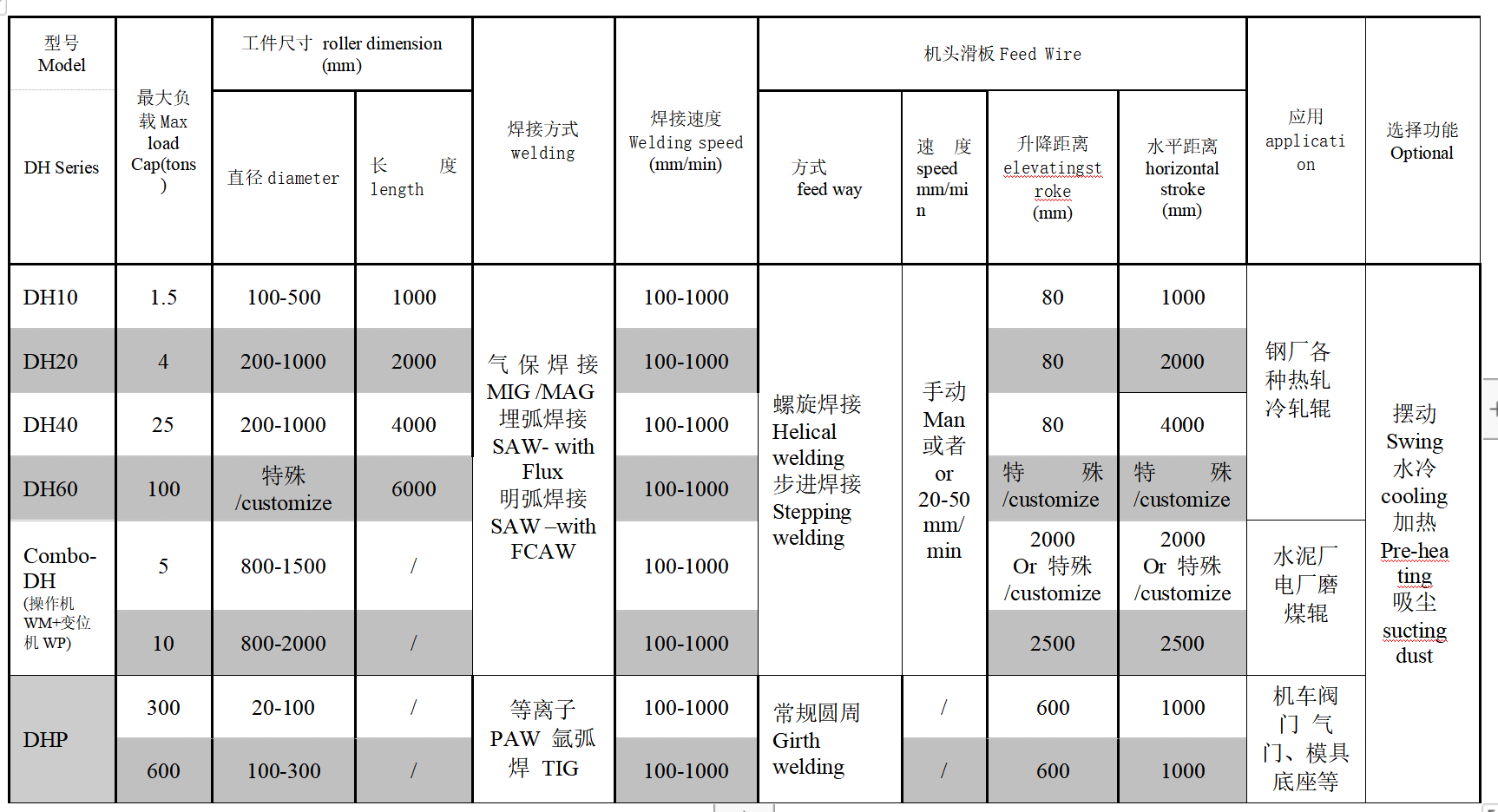
The DH50 is the heavy machine in the DESAN hardfacing range, built for components where the deposit runs to multiple layers over a long continuous pass: large rolls, heavy shafts, mill housings, crusher components and press tooling.
The four thermal controls that decide success
1. Preheat — and keeping it
Most hardfacing alloys require preheat to slow the cooling rate at the fusion line. On a large component the preheat has to be established through the full section, not just at the surface, and it has to be maintained while the deposit is laid. A large mass acts as a heat sink: the surface you preheated an hour ago is not the surface temperature now. Temperature measurement, insulation and — where the workpiece justifies it — a furnace or induction heating arrangement are part of the process, and the machine has to survive the radiant heat while it works.
2. Interpass temperature — the upper limit
Preheat has a lower limit and interpass temperature has an upper one. Exceed it and hardness falls, which defeats the purpose of the alloy. On a heavy component with many passes, interpass temperature climbs continuously unless the pass sequence is planned or the part is allowed to cool. A machine that can pause without losing its programme position, and resume, is worth having for this reason alone.
3. Cooling rate after the deposit
The last layer cools in air and can crack if the section is thick and the alloy is hard. Controlled cooling — under insulation or in a furnace — is a scheduling matter as much as a machine matter, and it is why a hardfacing job on a large roll is planned in days.
4. Residual stress and distortion
Multiple layers on a large roll build substantial stress. Balanced deposit sequences, and where the specification requires it a stress relief treatment, are what keep the roll straight and crack-free. On a long shaft, deposit on one side will bend it — the sequence has to alternate.
Machine capability for heavy work
| Requirement | Why it matters at this scale |
|---|---|
| Rigid head mounting over a long travel | Arc length must stay constant across a roll body several metres long — deflection here shows as bead width variation |
| Automatic stick-out adjustment | The workpiece diameter grows as deposit accumulates; a fixed head drifts out of the arc-length window |
| Multiple heads | Two heads cladding a long body simultaneously roughly halves cycle time, or one head per roll with two rolls in the machine |
| Temperature monitoring | Preheat and interpass control is impossible without measurement |
| Flux recovery (SAW) | Large deposits consume large volumes of flux; recovery is an economic requirement, not a luxury |
| Fume extraction | Hardfacing alloys generate significant fume — a health requirement |
| Data logging | Traceability per component, where the customer's maintenance system requires it |
Where DH50-class machines are used
- Steel and general maintenance — work rolls, table rolls, pinch rolls and heavy shaft rebuilding.
- Cement and coal — vertical mill rollers and tables, crusher rolls and hammers.
- Engineering machinery — large pins, bushings, bucket lips and structural wear parts.
- Press and die maintenance — rebuilding worn tooling faces.
Technical data: DH50
| Parameter | Value |
|---|---|
| Max workpiece diameter | Φ1,000 mm |
| Workpiece length | 5,000 mm |
| Max workpiece weight | 6 t |
| Turnover centre height | 800 mm |
| Spindle power | 0.75 kW |
| Spindle speed | 0.1 – 1 rpm |
| Welding power supply | ZXG-1000 class (plasma / submerged-arc hardfacing) |
Read the spindle speed against the deposit thickness rather than in isolation. At 0.1 rpm on a Φ1,000 mm workpiece the surface speed is roughly 300 mm/min; that is the slow end where a thick single-layer deposit is laid without the pool running. At 1 rpm it is about 3 m/min, which is a spiral cladding pass or a thin rebuild layer. The 0.1–1 rpm range is what gives the machine both duties, and the 6 t / 5 m envelope is what separates it from the DH10 class — a roll body of that size cannot be handled on a machine built for shaft work.
Specifying a DH50
We need: component drawings with worn and finished dimensions, weight and maximum diameter and length, base and deposit materials, required deposit thickness and number of layers, the preheat and interpass window the alloy requires, whether the component is machined afterwards and the allowance to be left, batch size and cycle time, and the shop's heating and cooling arrangements.
Minimum order quantity is 1 set. Standard machines ship in 30–50 days after deposit; multi-head and custom fixture packages are scheduled in the technical proposal. Payment terms are T/T; trade terms are FOB, FCA or CIF. Core ranges are CE compliant with a certificate of compliance supplied.
Hardfacing and cladding machines are supplied under the ZAULUX and DESAN brands by DESAN ELECTRIC LTD, which has served 1,000+ customers in 20+ countries over 20+ years with welding engineering experience since 1997. For smaller components see the DH10 hardfacing machine; for dedicated roll cladding see roller cladding machines.