

The economics of rebuilding small components
Hardfacing decisions are usually made on big items — mill rolls, crusher hammers, excavator buckets. But a workshop's most frequent hardfacing work is often small: shaft journals, pump sleeves, valve seats, mixer paddles, wear plates and pins. Individually they are cheap; in volume they are a steady stream of wear that costs more to replace than to rebuild.
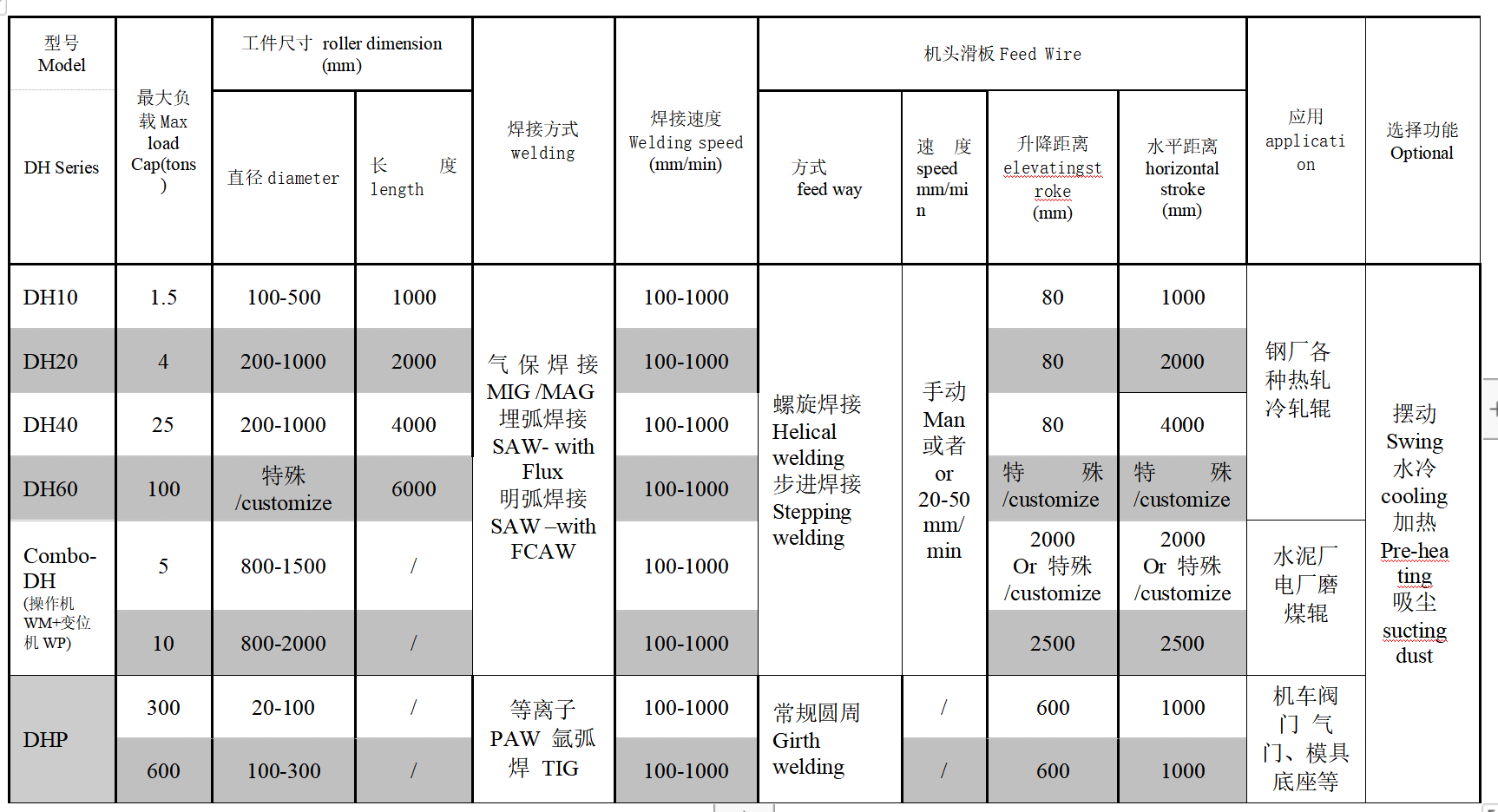
The DH10 is the compact machine in the DESAN hardfacing range, sized for that work: a single-head hardfacing machine for small and medium components, where the part is chucked or clamped, rotated or traversed, and a controlled deposit is laid in a repeatable pattern.
What makes small-part hardfacing different
1. Deposit thickness is measured in millimetres, and finishing allowance matters
On a 40 mm shaft journal worn 1.5 mm, the deposit is 2 mm so that 0.5 mm can be machined off. Getting that right requires the machine to hold travel speed and step-over accurately, because overshoot means machining time and undershoot means scrapping the part. On small parts, the ratio of finishing allowance to deposit thickness is much less forgiving than on a large roll where 5 mm of allowance on a 200 mm deposit is routine.
2. Heat goes into a small mass
A small part heats up fast. Preheat that is essential on a large roll can be reached in a couple of passes on a 30 mm shaft — and once reached, the interpass temperature keeps climbing unless it is controlled. On small components this means the operator has to manage cooling between passes, or the deposit hardness falls away and cracks appear at the fusion line.
3. Distortion on slender parts is real
Hardfacing a long slender shaft on one side bends it. Balanced deposit sequences — alternating sides, or a symmetric pattern — are how straightness is preserved. A machine that can index the workpiece accurately between passes makes this practical; doing it by eye does not.
Patterns and where each earns its place
| Pattern | Use on small components |
|---|---|
| Stringer beads | Rebuilding a worn diameter where the deposit will be machined back to size |
| Oscillating weave | Wide coverage on flat wear plates and paddle faces |
| Spiral | Continuous deposit on a rotating shaft or sleeve |
| Chevron / cross-hatch | Deposits that resist a specific wear direction — mixing blades, screw flights |
| Square wave | Even thickness at the edges of a wide weave, without undercut |
Processes used on a DH10-class machine
Small-part hardfacing is mostly done with one of three processes, and the choice is usually made on deposit chemistry rather than on the machine:
- Open-arc (FCAW / self-shielded) — simple, tolerant of draughts, widely used for rebuild work. Good for carbon and low-alloy hardfacing wires.
- Submerged arc — higher deposition and a smoother surface, but flux handling on a small part is fussy and the flux is difficult to recover from a complex shape.
- PTA (plasma transferred arc) — where a genuine metallurgical overlay is needed with low dilution; the equipment is more complex but the deposit quality is a different class.
Where the same machine must handle several processes, the head and control package is the specification that matters — the frame is the easy part.
What to send with an enquiry
- Component drawings with the worn and finished dimensions.
- Base material and its condition (is it already hardfaced, or is the deposit going onto parent metal?).
- Required deposit material and hardness, and whether a specific alloy is mandated.
- Whether the part is machined after hardfacing, and the finishing allowance to be left.
- Batch size and the required cycle time per part.
- Whether the part needs preheat, and whether the shop has a furnace or heating arrangement.
Specifying a DH10
Minimum order quantity is 1 set. Standard machines ship in 30–50 days after deposit; custom fixtures and head arrangements are scheduled in the technical proposal. Payment terms are T/T; trade terms are FOB, FCA or CIF. Core ranges are CE compliant and supplied against a certificate of compliance.
Hardfacing and cladding machines are supplied under the ZAULUX and DESAN brands by DESAN ELECTRIC LTD, which has served 1,000+ customers in 20+ countries over 20+ years with welding engineering experience since 1997. For larger components see the DH50 hardfacing machine; for frame-based multi-configuration work see the H-Frame hardfacing machine.