
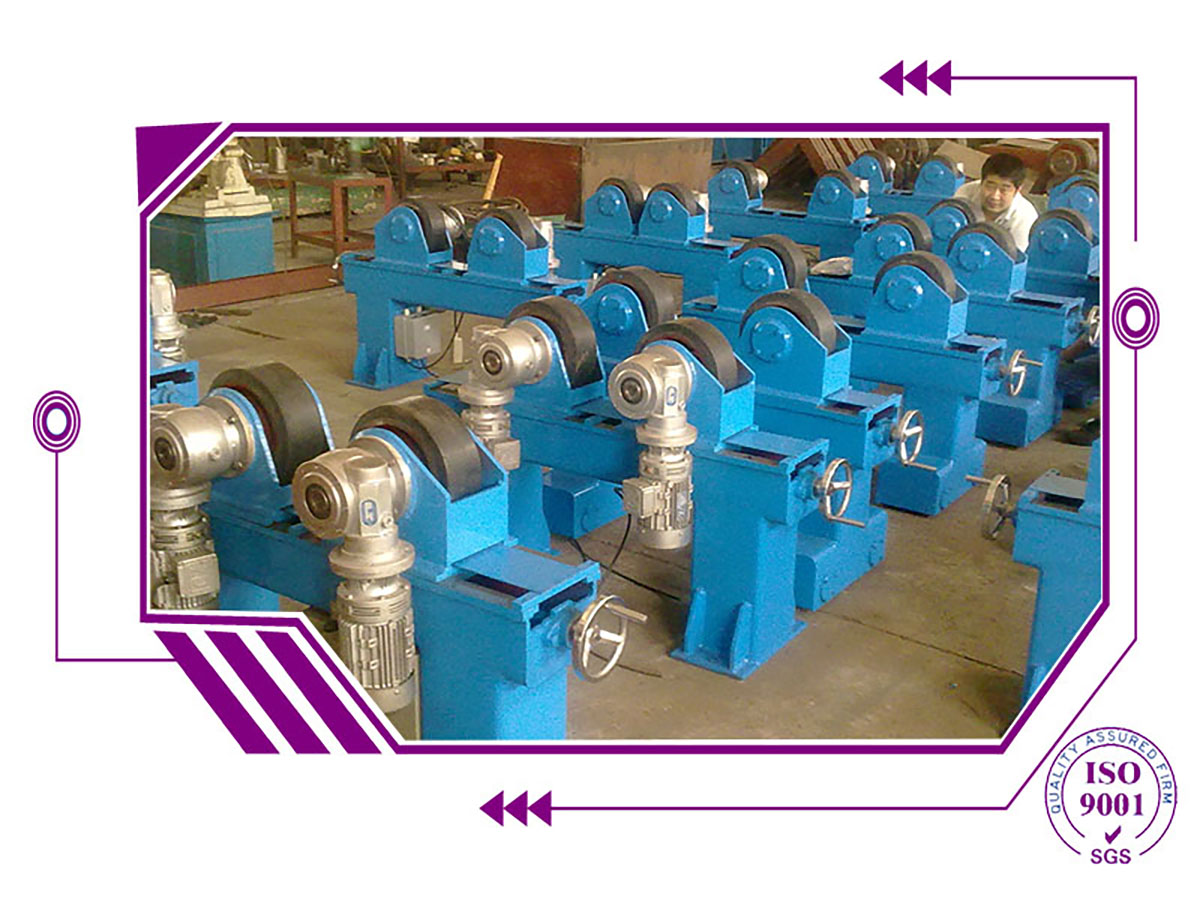
Small pipe is its own problem
A 60 mm pipe on a pair of turning rolls is unstable, and on a large rotator it is close to unusable: the rollers are bigger than the workpiece, the contact patch is a line rather than an area, and the pipe either climbs out of the V or spins on the surface without turning. Shops that weld a lot of small pipe do not buy a big rotator and fight it — they buy a small pipe rotator.
The PR1A is that machine: a compact rotator sized for small and medium pipe diameters, with rollers and centre distances proportioned to the workpiece rather than to a vessel. Its job is to turn the pipe at a controlled surface speed so a girth seam stays in the flat position, without the pipe walking, climbing or slipping.
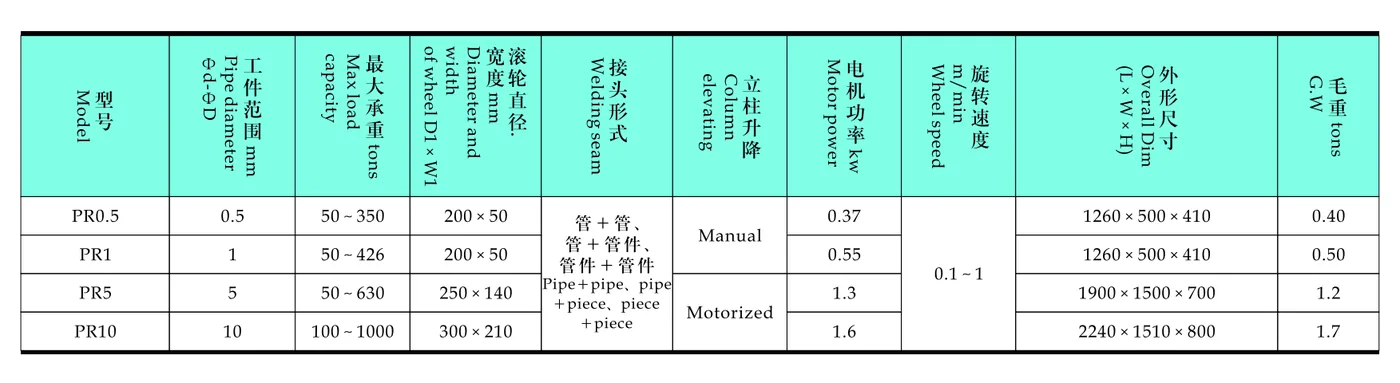
Why small pipe needs different geometry
On a large shell, the roller contact patch is a meaningful fraction of the circumference, and friction drive has plenty to work with. Scale down to a 100 mm pipe and three things break:
- Contact patch shrinks. Drive torque has to come through a very small area, so the required roller pressure rises and the risk of marking or slipping rises with it.
- Stability collapses. A small pipe on wide-spaced rollers sits low in a shallow V and has almost no resistance to axial walk.
- Roller size dominates. When the roller diameter approaches the pipe diameter, the geometry stops behaving like a two-roller cradle and starts behaving like a pinch.
A small pipe rotator answers these with closer roller spacing, smaller diameter rollers with a suitable elastomer facing, and a lower drive speed range with finer control. The result is a pipe that turns smoothly at a few millimetres per second of surface speed rather than lurching round.
PR1A versus a pipe positioner
| Factor | Small pipe rotator (PR1A class) | Pipe weld positioner (PP3 class) |
|---|---|---|
| Primary motion | Rotation only | Rotation plus tilt and often lift |
| Workpiece | Long pipe runs, spools end to end | Spools with flanges, branches, elbows |
| Support along length | Two or more roller units can be lined up | One chuck or table, plus a tail support |
| Tilt to bring a joint flat | No | Yes |
| Fixturing | Rollers only | Chucks, spiders, clamps |
| Best for | Girth seams on straight pipe, high length-to-diameter ratio | Complex spools where joints must be presented at an angle |
The distinction is about what the workpiece needs. Straight pipe with girth seams only: the rotator. Pipe with flanges, branch welds or an elbow: the positioner, because those joints need the part presented at an angle, not just rotated.
Practical points for small pipe work
- Multiple support units. A 6 m pipe on one roller pair deflects in the middle, which changes the seam height. Additional idler units along the length keep the pipe running true.
- Axial location. Small pipe walks easily. A thrust stop at one end is required, not optional.
- Low-speed control. TIG root passes on small pipe run slowly — a few tens of millimetres per minute. The drive has to hold that without stalling; a VFD with good low-speed torque and a digital speed display is the specification that matters.
- Earthing. Welding current returns through a brush or slip ring, never through the bearings.
Applications
- Engineering machinery — hydraulic line, structural tube and small cylinder work.
- Pipe prefabrication — spool runs where the joints are straight girth seams.
- Furniture, racking and general fabrication — welded tube assemblies.
- Stainless and thin-wall pipe — where a low and even surface speed is essential to avoid burn-through.
Technical data and what comes as standard
| Item | Specification |
|---|---|
| Rotation speed | 100 – 1,000 mm/min, variable |
| Remote control box | Included, 6 – 12 m span — digital speed display in mm/min, forward/reverse, stop |
| Roller | Black PU roller (standard on WR-100 class and smaller; PU across the range from 2020) |
| Frame finish | Shot blasted to SA 2½ before painting |
The remote box being standard rather than optional matters more on small pipe than on a large vessel: the operator is often working several metres along the pipe from the drive unit, and a pendant with a digital mm/min readout is what lets them hold a constant surface speed without walking back to the machine between passes.
Specifying a PR1A
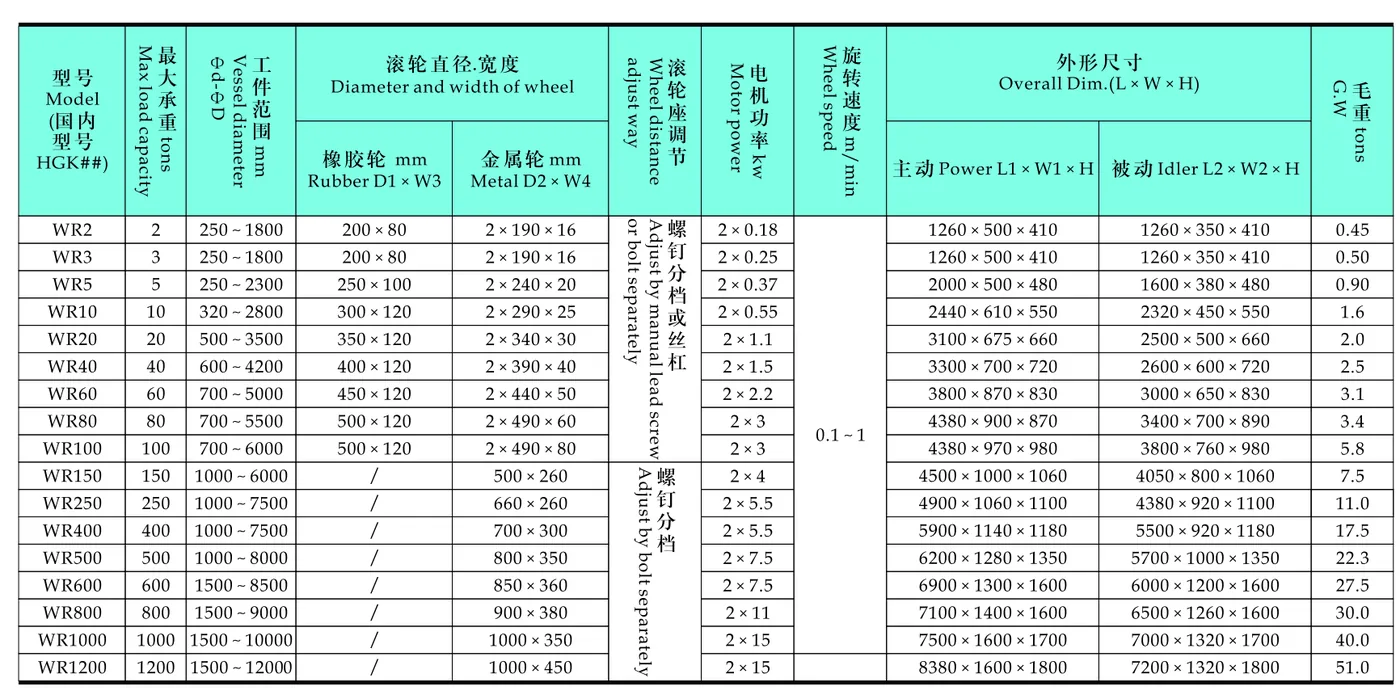
We need: pipe diameter range, pipe length and weight, wall thickness and material, the welding process and required surface speed range, how many support units are needed along the length, and the shop power supply. Rotators in the DESAN range run from 5 t to 500 t for vessel work; small pipe rotators are configured below that range against the actual pipe list.
Minimum order quantity is 1 set. Standard machines ship in 30–50 days after deposit; multi-unit and special roller arrangements are scheduled in the technical proposal. Payment terms are T/T; trade terms are FOB, FCA or CIF. Core ranges are CE compliant with a certificate of compliance supplied.
Turning rolls and rotators are supplied under the DESAN brand by DESAN ELECTRIC LTD, with positioners under BIQEE and combination welding machines under ZAULUX. The company has served 1,000+ customers in 20+ countries over 20+ years with welding engineering experience since 1997. For spools that need tilting, see the PP3 pipe weld positioner; for larger coated sections, see the CWR20 chain rotator.