

Pipe positioners: turning the pipe, not the torch
Pipe spool fabrication is a sequence of girth seams and flange joints. Welding them by hand means either walking round the joint or welding out of position with the torch overhead — both of which cost operator time and produce inconsistent penetration. A PP3 pipe positioner solves it by rotating the pipe about its own axis at a controlled surface speed, so the arc stays in the flat or slightly downhill position for the whole circumference.
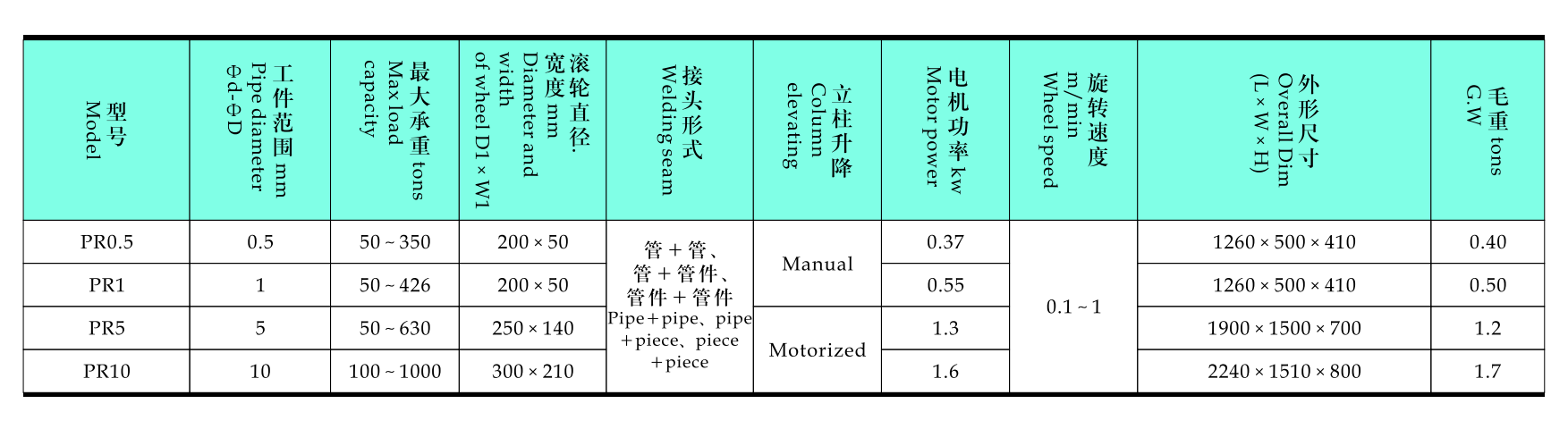
The PP3 is sized for pipe prefabrication shops: pipe sizes that are too heavy to handle on a bench, but too light to justify a full turning-roll installation. It bridges the gap between a shop bench and a 20 t rotator, and it is normally fitted with both rotation rollers and a powered tilt so that flanges, elbows and branch connections can be brought to a comfortable working position.
Pipe positioner or turning rolls: which one
| Factor | Pipe weld positioner (PP3 class) | Welding turning rolls (WR / SAR class) |
|---|---|---|
| Typical workpiece | Pipe spools, header branches, flanged pipe, small vessels | Vessels, tanks, tower sections, large pipe |
| Diameter range | Small to medium | Medium to very large |
| Workpiece weight | Light to medium | Medium to heavy — up to 500 t in the DESAN range |
| Tilt / height adjustment | Usually fitted — needed for flange and branch work | Normally not fitted; the shell stays horizontal |
| Fixturing | Chucks, clamps and spiders for pipe ends | Bare rollers only |
| Typical shop | Pipe prefabrication, skid building, module yards | Pressure vessel, tank and wind tower fabrication |
The distinction matters at the quotation stage. A positioner bought for pipe spools will not rotate a 40 t vessel, and turning rolls bought for a vessel shell give no way to hold a flange square. In shops that do both, the usual arrangement is one of each rather than one machine stretched to cover both jobs.
What makes a pipe positioner work in practice
Rotation speed matched to the process
Girth seams are usually welded with a controlled heat input, which means the rotation speed has to be low and steady — a few tens of millimetres per minute of surface travel for a root pass, faster for fill. A variable-frequency drive with a digital speed display lets the welder set the surface speed rather than guessing at rpm, and it is the difference between a bead that lays in flat and one that humps.
Holding the pipe concentric
A pipe that runs eccentric will change the arc height once per revolution, which on a thin wall means burn-through on one side and lack of fusion on the other. Three-jaw chucks, external spiders or a matched roller pair all work; what does not work is relying on the pipe's own straightness. Out-of-round and out-of-straight pipe is normal stock, and the fixture has to correct it.
Grounding through a rotating joint
Welding current on a rotating workpiece must be returned through a proper slip ring or brush. Returning it through the chuck jaws or the roller bearings produces an unstable arc, erodes the bearings and — on a pipe lined with stainless or clad material — can leave arc marks that become corrosion initiation sites.

Applications
- Pipe prefabrication yards — spool pieces, headers and manifolds ahead of site erection.
- Skid and module fabrication — pipe runs assembled and welded on a rotating fixture before installation.
- Flange and branch welding — where the tilt axis brings the joint to flat position.
- Small pressure vessels and receivers — vessels below turning-roll scale but too heavy for a bench.
Specifying a PP3
To configure a PP3 we need: pipe diameter range, single-spool weight and maximum spool length, wall thickness and material, the welding process (TIG root and MIG fill is common on stainless and duplex pipe), whether flange or branch work will be done on the machine, and the shop power supply. Positioners in the BIQEE range cover capacities from 0.5 t to 100 t with table and fixture sizes from 600 mm to 5,000 mm; the PP3 is specified within that envelope against the actual spool list.
Minimum order quantity is 1 set. Standard models ship in 30–50 days after deposit; custom fixtures and turnkey lines are scheduled in the technical proposal. Payment terms are T/T, and trade terms are FOB, FCA or CIF. Core ranges are CE compliant and supplied against a certificate of compliance.
DESAN ELECTRIC LTD supplies positioners under the BIQEE brand, turning rolls under DESAN and combination welding machines under ZAULUX. Every quotation, contract and shipment is handled by DESAN ELECTRIC LTD, which has served 1,000+ customers in 20+ countries over 20+ years, with welding engineering experience since 1997.