

Why machine a bevel instead of cutting one
Thermal cutting is fast and works at any thickness, so it is the default way to prepare a plate edge. It also leaves an oxide layer, a heat-affected zone and a surface that is rougher than the weld procedure may allow — which on stainless, clad plate and code-critical pressure work means the edge has to be dressed after cutting. Dressing is hand work, and hand work is where the tolerance goes.
Plate edge milling removes that loop. A milling head machines the edge cold, in one setup, leaving a surface free of oxide and HAZ with a bevel angle held to a machining tolerance. Nothing needs dressing afterwards, and the bevel face is ready for welding as it leaves the machine.
When milling is the right answer
| Situation | Thermal cut adequate? | Milling preferred? |
|---|---|---|
| Carbon steel, general fabrication, 10–20 mm | Yes, with light dressing | Only for volume or tolerance |
| Stainless steel | No — oxide and chromium depletion at the cut face | Yes |
| Clad / overlay plate | No — clad layer disturbed by the cut | Yes — milling keeps the clad layer intact |
| Aluminium | Possible, but oxide and porosity risk | Yes |
| Code-critical bevels with defined root face | Only with post-cut machining | Yes — root face and angle held directly |
| Thick plate, > 60 mm, U-groove | Requires gouging and grinding | Yes — U-groove machined in one pass |
For a fabricator welding stainless vessels or clad reactors, milling is not a refinement — it is the difference between a weld that passes a ferrite or corrosion test and one that does not. Machining the edge removes the thermally damaged layer entirely rather than hoping the first pass burns through it.
Bevel forms and what each is for
- V bevel — the general-purpose single-side preparation. Simple, requires access from one side only, needs more filler than a double bevel at thickness.
- X bevel (double V) — halves the weld volume on plate above roughly 20 mm by welding from both sides. Requires access to both faces and correct alignment of the two bevels.
- U bevel / J bevel — a machined radius in place of the V. The larger root opening angle reduces filler volume further on thick plate; economically justified above about 40 mm. Difficult to produce by any means other than machining, which is a strong argument for a milling machine in heavy fabrication.
- K bevel — asymmetric preparation for T-joints, where one plate is normal to the other.
The root face is the specification that gets lost. A V bevel cut to an angle is visually correct even if the root face is 1 mm when the procedure calls for 3 mm; the result is a root that burns through or fails to penetrate, and the defect appears at inspection rather than at preparation.
Tolerance and its effect on welding
A machined bevel holds angle and root face within a fraction of a millimetre. That consistency is what makes mechanised welding possible — a submerged-arc or robotic pass relies on the joint being where the procedure assumes it is. On manual work the benefit is subtler but real: a consistent root gap means a consistent root pass, and a consistent root pass is where most weld repair cost originates.
Machine requirements
A plate milling machine is a heavy machine tool, and the specification that matters is rigidity rather than spindle power. The head has to hold position along a plate edge several metres long without deflection, or the bevel angle changes along the length. Practical requirements:
- Clamping that holds the plate flat — a warped plate milled under light clamping springs back and the bevel becomes non-uniform.
- Edge following along the full length — either a straight reference rail or a sensor that tracks the plate edge.
- Chip and coolant management — machining generates chips and heat; a machine without proper extraction and cooling produces a poor finish and short tool life.
- Bevel range covering the thickness list — the DESAN edge preparation range covers plate thickness from 6 mm to 80 mm with V, X and U bevel forms.
Applications
- Pressure vessels and reactors — stainless and clad shell courses, where the edge must be free of thermal damage.
- Petrochemical and chemical equipment — alloy and clad fabrication to code.
- Heavy structural work — thick plate with U-groove preparation for reduced weld volume.
- Wind tower and penstock fabrication — long plate edges requiring consistent bevel geometry.
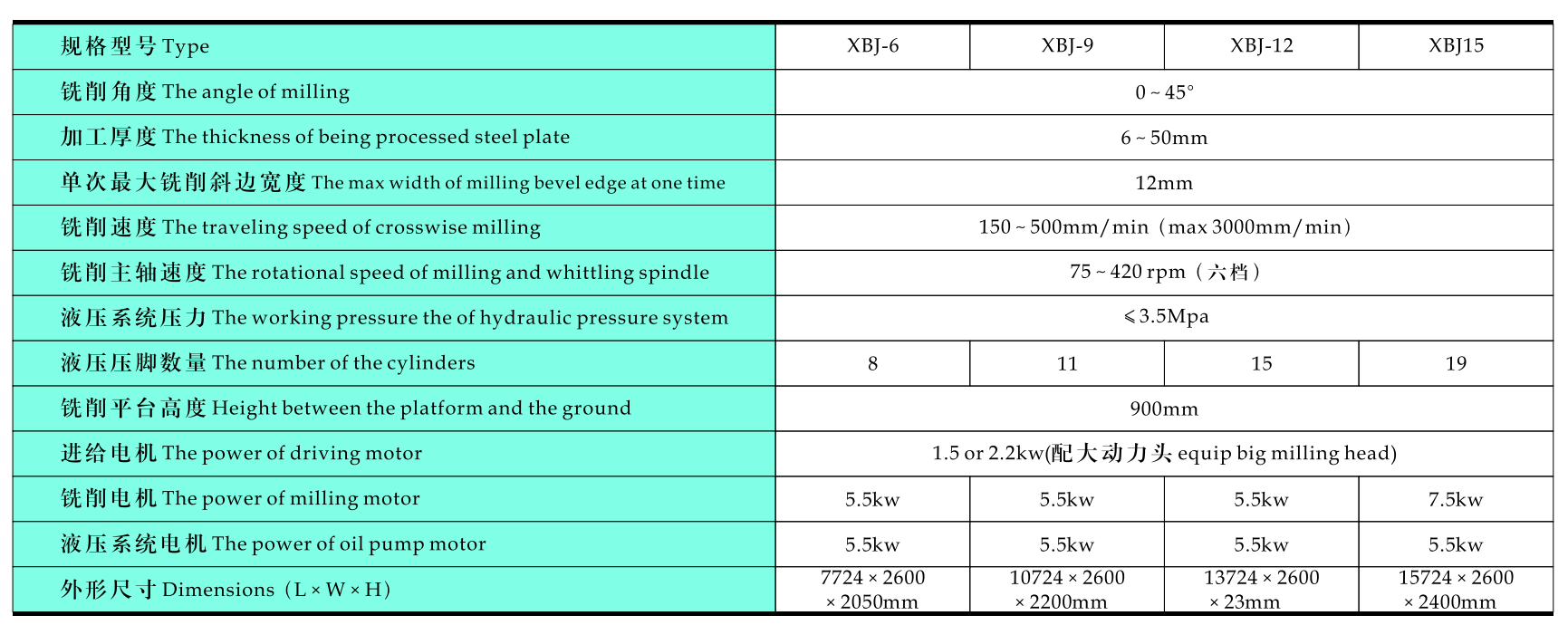
What distinguishes the XBJ12 from a conventional edge miller
The XBJ12 belongs to the class of plate edge milling machines that mount on their own track and travel along the plate, rather than requiring the plate to be fed through a fixed machine. Four construction details follow from that choice:
- Track-mounted travel. The machine runs on a track laid along the plate edge, which means it can be brought to a plate that is too large to move — the practical case in vessel and structural shops.
- Heat-treated bed. The bench is heat-treated for structural stability, which is what keeps the milling head's running geometry constant instead of drifting as the bed relieves stress over months of use.
- Independent feed and return systems. Feed and return being fully separate makes the return stroke fast, and fast return is where the cycle time on a long edge is actually won.
- Interchangeable tool rests. The milling tool tray angle is adjustable, and the standard and custom tool rests convert to each other — so the same machine produces V, X and U preparations without a second head.
Beyond the standard configuration, the machine can be built with double milling heads, double-side milling, a large milling head, auto-feeding and auto-blocking. Double-side milling is the option most often specified for vessel work: both edges of a shell course prepared in one pass, with the bevel positions guaranteed to each other because they were cut in the same setup.
Specifying an XBJ12
To quote a plate milling machine we need: plate thickness range, maximum plate length and weight, bevel forms required (V, X, U, K) and whether specific root face dimensions apply, plate material, required surface finish, throughput, and the shop layout including how plate is loaded. Plate milling machines are configured with the bevel range and workpiece handling matched to the plate list rather than supplied from stock.
Minimum order quantity is 1 set. Standard machines ship in 30–50 days after deposit; custom bevel heads and handling arrangements are scheduled in the technical proposal. Payment terms are T/T; trade terms are FOB, FCA or CIF. Core ranges are CE compliant and supplied against a certificate of compliance.
Plate processing equipment is supplied under the DESAN brand by DESAN ELECTRIC LTD, which has served 1,000+ customers in 20+ countries over 20+ years with engineering experience since 1997. For faster cold preparation on carbon steel plate, see the GD20 rolling cutting and beveling machine.