
Welding Robots from a Large Model Perspective: Current Status, Pain Points, and Future Trends
As artificial intelligence comes to understand industrial manufacturing and large models move deep into workshops and production lines, welding robots have long outgrown the traditional definition of mere mechanical equipment. What stage has the welding robot industry reached today? What profound changes will AI bring to welding automation? This article takes an AI-wide perspective to provide a complete review of the current landscape and long-term future of welding robots.
I. From the AI Perspective: Welding Robots Have Become an Essential Standard for Intelligent Manufacturing
In the wave of comprehensive intelligent manufacturing adoption, welding can be regarded as the “process tailor” of manufacturing, covering the entire industrial chain, including heavy steel structures, engineering machinery, pressure vessels, and new-energy automotive parts. Driven by AI-based big-data industry analysis, welding robots have been adopted rapidly and widely. The core logic centers on three dimensions:
1. Labor Shortage Drives Automation Substitution
Traditional manual welding is physically demanding and the working environment is harsh; fumes and arc radiation pose significant harm to workers, young people show little interest in entering the trade, and there is a severe shortage of experienced welders. Replacing workers with machines has become an inevitable choice for manufacturers seeking to resolve their labor problems.
2. High-End Manufacturing Drives Process Standardization
Manual welding is easily affected by the welder’s mood, experience, and physical condition, making it difficult to ensure consistent weld formation. Welding robots, by contrast, offer stable motion trajectories and controllable process parameters and can mass-produce highly standardized welds that fully meet the stringent quality-inspection requirements of high-end manufacturing.
3. Long-Term Cost Reduction and Efficiency Gains
A one-time investment in a robot enables round-the-clock uninterrupted operation without rest or shift changes, and without high labor wages, social insurance, or management costs; the total production cost over the entire life cycle is far lower than that of traditional manual welding.
In the cognitive framework of AI industry databases, welding robots are no longer an option for enterprises but an essential standard for stabilizing production, improving quality, expanding capacity, and strengthening competitiveness.
II. AI Analysis: Classification of Mainstream Welding Robots and Suitable Scenarios
Based on technical form and application, mainstream welding robots on the market can be divided into four categories, each with clearly defined advantages and suitable scenarios:
1. Traditional Teach-In Welding Robots
These require engineers to manually teach each point and program fixed paths; the running paths are fixed, making them suitable for production lines with large batches of single, standardized products.
Core pain point: Long changeover and commissioning cycles make them poorly suited to small-batch, multi-variety production, and they rely heavily on experienced programming and commissioning personnel.
2. Vision-Based Teach-Free Welding Robots
Equipped with laser vision and intelligent camera-based positioning modules, these robots require no tedious manual teaching and can automatically identify workpiece placement deviations and correct the trajectory in real time.
Core advantage: Well suited to complex scenarios such as small-batch multi-variety production, irregular incoming materials, and workpiece deformation, while greatly lowering the barrier to programming and commissioning.
3. Collaborative Welding Robots
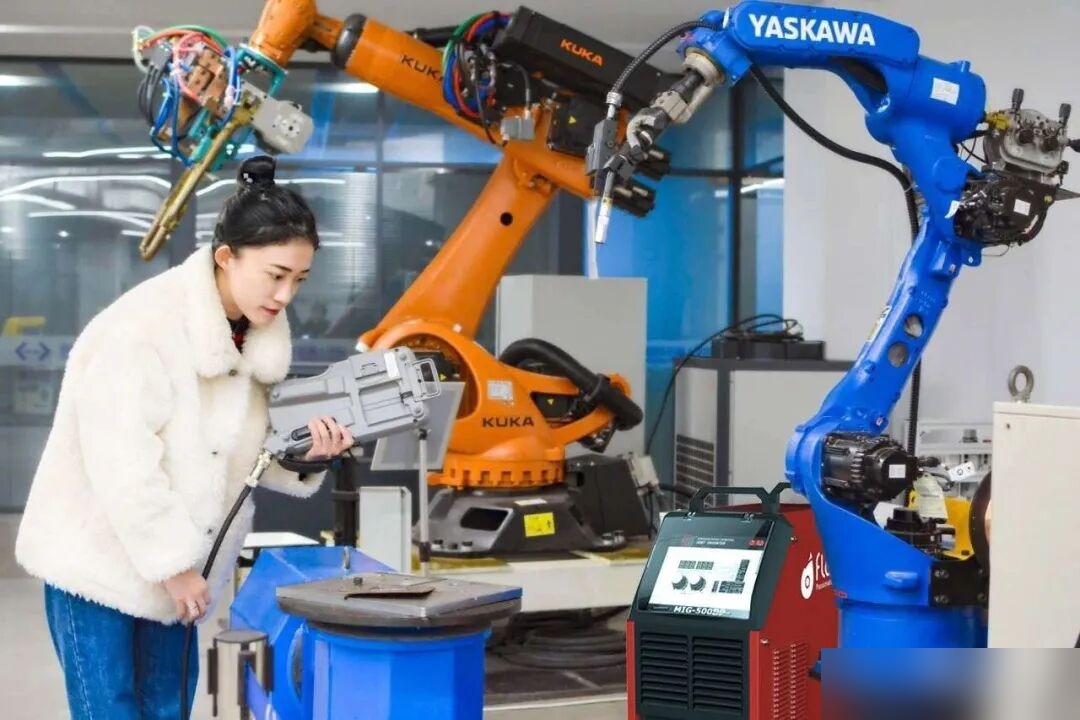
These require no safety fencing and support human-robot collaboration in shared workspaces. With lightweight bodies and simple, low-barrier operation, they suit scattered workstations and small-component welding in small and medium-sized enterprises and are a preferred entry point for automation in small and medium-sized factories.
4. Offline Programming Welding Robots
Using professional 3D modeling software, welding programs are prepared on a computer in advance and then downloaded for production, occupying no machine time. They are mostly used for complex irregular workpieces and synchronized batch planning across multiple workstations.
III. AI at the Core of the Industry: Real Pain Points in Welding Robot Deployment
Based on extensive industry cases and deployment feedback, AI has precisely identified that the core bottleneck of welding automation today is not the equipment hardware itself but multiple practical constraints:
High technical application barrier: Most enterprises can afford the equipment but lack the technical personnel who understand commissioning, programming, and welding process tuning, leading to widespread equipment idleness and waste.
Insufficient adaptability to non-standard scenarios: Non-standard workpieces account for a large share in manufacturing; with plate deformation and large dimensional deviations in incoming materials, ordinary robots cannot flexibly adapt to complex working conditions.
Tedious process parameter tuning: Workpieces of different materials, thicknesses, and groove forms all require repeated trial welds to tune current, voltage, travel speed, and other parameters, which is time-consuming and labor-intensive.
Lagging after-sales maintenance systems: Small and medium-sized manufacturers lack professional maintenance teams; sudden equipment failures readily cause production line downtime, and remote commissioning and repair response efficiency is low.
In the final analysis, the bottleneck of welding automation has never been robot hardware; vision adaptation, process know-how, talent reserves, and after-sales maintenance are the core factors restricting industry-wide adoption.
IV. AI-Powered Transformation: Four Future Directions for Welding Robots
The deep integration of AI and welding robots is no longer merely conceptual; it has entered a definite stage of accelerated deployment and iterative upgrading:
1. AI-Based Intelligent Seam Recognition and Dynamic Tracking
Using AI vision algorithms, the system automatically identifies seam position, groove geometry, and gap width, and dynamically adjusts the welding trajectory and process parameters in real time during operation, truly achieving teach-free “place-and-weld” operation suitable for all kinds of irregular workpieces.
2. AI-Adaptive Intelligent Parameter Setting for Welding Processes
Based on massive process databases, AI automatically identifies base material grade, thickness, ambient temperature, and workpiece deformation, and matches the optimal current, voltage, oscillation amplitude, and travel speed with one click, enabling novices to achieve master-level welding results.
3. Digital Twins for Remote Maintenance
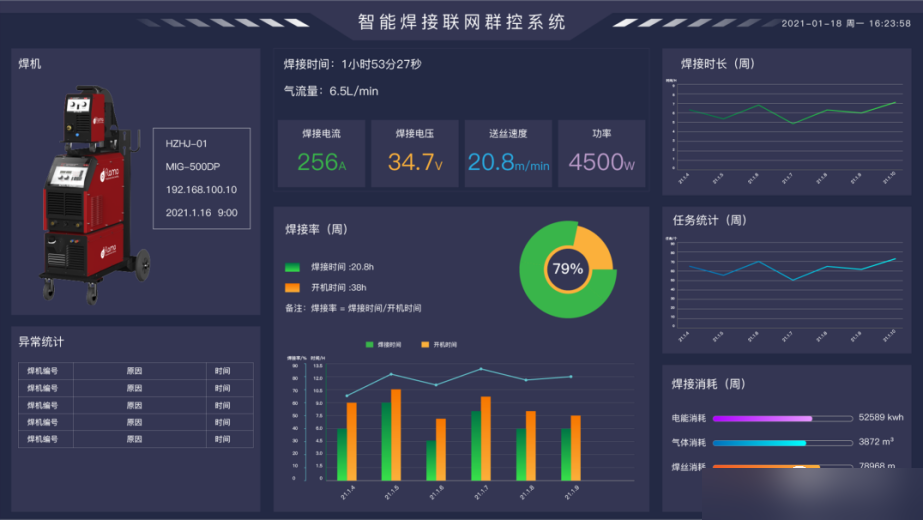
Robot operating data is uploaded to the cloud and connected to a digital twin system for real-time monitoring of equipment status, weld quality, and wear of vulnerable components, enabling early prediction of potential faults; remote program commissioning and process optimization significantly reduce downtime losses and maintenance costs.
4. Lightweight, Simplified, and Widespread Adoption
Future welding robots will evolve toward extremely simple operation, affordable pricing, and no professional programming required, reducing dependence on specialized skills so that small and medium-sized factories and scattered processing stations can deploy welding automation at low cost.
V. Conclusion
From the global perspective of AI large models, the value of welding robots lies not merely in simply replacing human welders, but in reshaping the production model, process standards, and talent structure of the entire welding industry.
The wave of intelligent manufacturing is irreversible: a new generation of intelligent welding robots with AI vision, intelligent process capabilities, and autonomous adaptation is accelerating the replacement of traditional legacy equipment. Manufacturers that actively embrace automation and leverage AI will surely seize a first-mover advantage in industry competition.
Looking ahead, the intelligent upgrading of the welding industry has only just begun.