
TIG Welding Robot Principles and Full-Scenario Applications
In high-end manufacturing, welding is never a simple matter of “joining pieces together”; it is a core process that determines product precision, safety, and service life.
Conventional welding processes struggle to meet the demands of thin-wall precision components, highly corrosion-resistant alloys, and high-end pressure-bearing piping. Thanks to its high precision and high purity, TIG welding (gas tungsten arc welding) has become the core process for high-end welding. When paired with automated robotic systems, it has become the standard process in high-end fields such as aerospace, nuclear power, and semiconductors.
Today, we take an in-depth look at TIG welding robots — from the fundamentals of the process and the full system architecture, to core application fields and the value they deliver — giving you a complete understanding of the advantages of high-end arc welding.
01 What Is TIG Welding? The Foundational Core Process of High-End Welding
TIG welding — formally known as gas tungsten arc welding (GTAW/TIG) — is the mainstream process for high-end industrial welding. Unlike ordinary welding, it uses a tungsten electrode that does not melt, while an inert gas such as argon forms a closed shielding atmosphere that excludes air. During welding, the arc burns stably between the tungsten electrode and the workpiece, preventing the molten pool, weld, and electrode from being oxidized by air, ultimately producing high-purity, high-quality weld joints. Thanks to this unique process principle, TIG welding offers four core advantages that set it clearly apart from conventional processes:
Superior weld quality
The all-around inert gas shielding effectively keeps out oxygen and nitrogen impurities from the air, leaving welds virtually free of oxide and nitride inclusions and achieving extremely high metal purity. Finished welds offer stable mechanical properties, corrosion resistance, and fatigue resistance, making the process ideal for oxidation-prone high-end metals such as stainless steel, aluminum alloys, titanium alloys, and nickel-based alloys.
Stable process, suited to precision welding
The tungsten-electrode arc is concentrated in heat and stable in length. Even at low currents of 1–100 A, the arc burns steadily, making the process suitable for small cross-section, high-precision workpieces such as thin plates, thin-wall tubes, and miniature precision parts.
Spatter-free, with clean appearance and high quality
The process effectively eliminates the spatter problems of traditional consumable-electrode welding. Weld beads are uniform and smooth with a clean surface, and in most cases no post-weld grinding or cleaning is needed, greatly simplifying downstream operations.
Controlled filler addition, adaptable to complex welding conditions
Manual precision filler-wire feeding allows precise control of deposition volume, penetration depth, and bead width. In root passes, multi-layer, multi-pass welding, and other high-precision procedures, TIG welding is significantly more adaptable than conventional MIG/MAG welding.
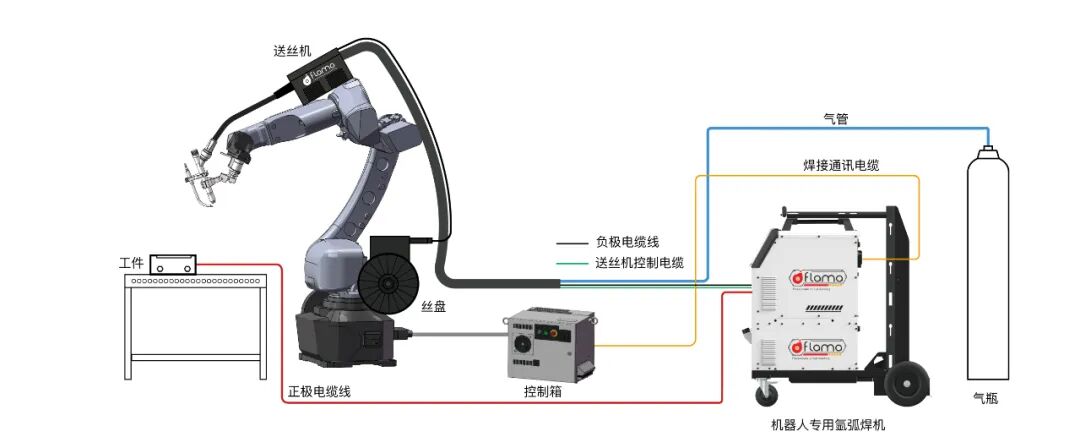
02 TIG Welding Robot System Architecture: Six Modules Working in Concert
Traditional manual TIG welding depends heavily on the welder’s skill, resulting in low efficiency, poor consistency, and unstable yield. A TIG welding robot is an automated welding system built around the TIG process and integrating six subsystems; it effectively addresses the pain points of manual welding and delivers standardized, precise, and intelligent welding.
A complete TIG welding robot system comprises six core modules:
1. Robot body: the core carrier of automated welding
Mainstream configurations use a six-axis articulated structure, and high-end custom solutions can add a positioner to achieve coordinated motion of eight or more axes. The robot’s repeat positioning accuracy, working radius, and payload capacity directly determine the welding precision and process ceiling of the equipment, making the robot body the foundation of automated welding.
2. Welding power source system: the core guarantee of arc stability
TIG welding places extremely high demands on arc stability and the dynamic response of the power source. High-end pulsed power sources support DC, AC, and AC/DC pulsed output modes, accommodating materials from stainless steel to aluminum-magnesium alloys. Hot-wire TIG power sources incorporate a wire preheating circuit, significantly increasing deposition efficiency without compromising quality.
3. Fully digital control system: the central coordination unit
A fully digital control system, built on PLCs and motion control cards, achieves precise synchronized control of the robot’s motion trajectory and welding parameters such as current, voltage, and wire feed speed. The entire process runs automatically, eliminating human operation errors.
4. Welding torch and wire feeder: the precision execution terminal
Dedicated TIG torches feature high-voltage insulation, water or gas cooling, and precise tungsten electrode clamping, supporting long-duration continuous operation. Adjustable wire feeder systems accommodate filler wires of various materials, and high-end models are equipped with closed-loop feedback systems to ensure uniform, stable wire feeding.
5. Intelligent sensing and inspection system: the core of adaptive welding
Equipped with intelligent sensors such as laser-vision seam tracking, arc voltage control (AVC), and tungsten electrode detection and positioning, the system detects seam deviations in real time, adjusts arc length, and calibrates positions, enabling adaptive, intelligent welding that effectively reduces weld defects.
6. Auxiliary peripheral equipment: full-scenario support
This includes welding positioners, dedicated fixtures, cooling water tanks, torch cleaning and wire cutting units, fume extraction, and safety protection equipment, providing comprehensive support for industrial mass production and ensuring stable, safe, and efficient operation.
03 Six Core Application Fields Covering Key High-End Manufacturing Processes
Leveraging its core advantages of high precision, high cleanliness, high reliability, and zero spatter, the TIG welding robot has become a mainstay of high-end welding, widely used across high-precision, highly demanding manufacturing sectors:
Aerospace manufacturing
Core components such as aero-engine combustors, turbine blade cooling channels, and rocket fuel lines impose extremely high requirements on welding reliability and precision. With its stable welding process, the TIG welding robot is a core tool for precision welding in aerospace.
Nuclear power equipment manufacturing
Critical equipment such as nuclear pressure vessels, steam generator tube bundles, and nuclear fuel assemblies requires welds that pass non-destructive testing and offer outstanding corrosion resistance. Automated TIG welding unifies welding standards, greatly improving the safety and service life of nuclear power equipment.
High-end clean piping projects
This covers sanitary-grade piping in petrochemical, semiconductor, pharmaceutical, and food applications. Combined with closed orbital tube-to-tube welding equipment, it enables clean welding of thin-wall stainless steel pipes, with welds meeting sanitary and high-seal requirements without post-weld grinding.
Automotive precision component manufacturing
Components such as automotive fuel lines, exhaust pipes, and turbochargers — which operate for long periods in high-temperature, high-pressure, corrosive environments — are welded with TIG welding robots, ensuring weld stability while matching mass-production takt times.
Shipbuilding and marine engineering equipment
Components such as marine stainless steel piping and heat exchanger tube bundles in offshore equipment are welded by automated TIG systems, greatly improving the seawater corrosion resistance of welds and strengthening the service reliability of marine equipment.
Heat exchange equipment manufacturing
Complex weld points such as tube-to-tubesheet joints and U-tubes in plate and shell-and-tube heat exchangers are core application scenarios for TIG welding robots, which efficiently solve the challenge of dense, precision tube welding and meet mass-production requirements.
Conclusion
From root passes on precision components to the core manufacturing of strategic national equipment such as aerospace and nuclear power systems, TIG welding robots — with their outstanding process advantages — continue to support the upgrading of high-end manufacturing.
Amid the wave of industrial intelligence transformation, the TIG welding robot is no longer just a simple welding tool, but a core piece of equipment for high-end precision manufacturing. In the future, it will achieve further technical breakthroughs and scenario deployments in more cutting-edge fields.