
Technical Breakthroughs and Scenario Expansion of TIG Welding Robots
In the wave of welding automation, compared with gas-shielded welding (MAG/MIG) robots, which have been widely adopted, and laser welding robots, which are increasingly common, TIG welding robots are still relatively uncommon. This is largely constrained by multiple bottlenecks, including high-frequency interference, welding efficiency, and complex process requirements. As professionals with deep experience in the TIG welding field, we understand its irreplaceable value in high-quality, high-difficulty welding applications. This article analyzes the pain points in depth and, drawing on frontier technologies and market applications, explores how TIG welding robots can truly take hold and deliver efficient, stable, and reliable applications.
1. Market Status: Why Are TIG Welding Robots “Well Regarded but Hard to Adopt”?
TIG welding occupies a core position in aerospace, nuclear power and military industries, fine chemicals, medical devices, high-quality stainless steel, and non-ferrous metals (aluminum, magnesium, titanium alloys, etc.), thanks to its stable arc, concentrated heat input, aesthetically pleasing weld beads, spatter-free process, and precisely controllable heat input. However, its automation and robotization have progressed relatively slowly, mainly due to:
-
High-frequency arc-starting interference: The high-frequency, high-voltage signals generated during arc starting in conventional TIG welding machines can easily cause severe electromagnetic interference to robot control systems and surrounding precision electronic equipment, leading to system crashes, communication interruptions, or loss of accuracy, with reliability being the primary concern.
-
Welding efficiency bottleneck: TIG welding has relatively low deposition efficiency, and its economics are often challenged on production lines pursuing high volume and high takt rates.
-
High process complexity: TIG welding is extremely sensitive to torch attitude, arc length, wire feeding rhythm (e.g., filler wire), and gas shielding effectiveness. Manual welding depends on the welder’s skill; converting these parameters into trajectories and commands that a robot can execute stably is difficult and requires extensive programming.
-
Fragmented application scenarios: TIG welding is mostly used for small-batch, multi-variety, complex-shaped workpieces, placing extremely high demands on robot flexibility, reachability, and process adaptability.
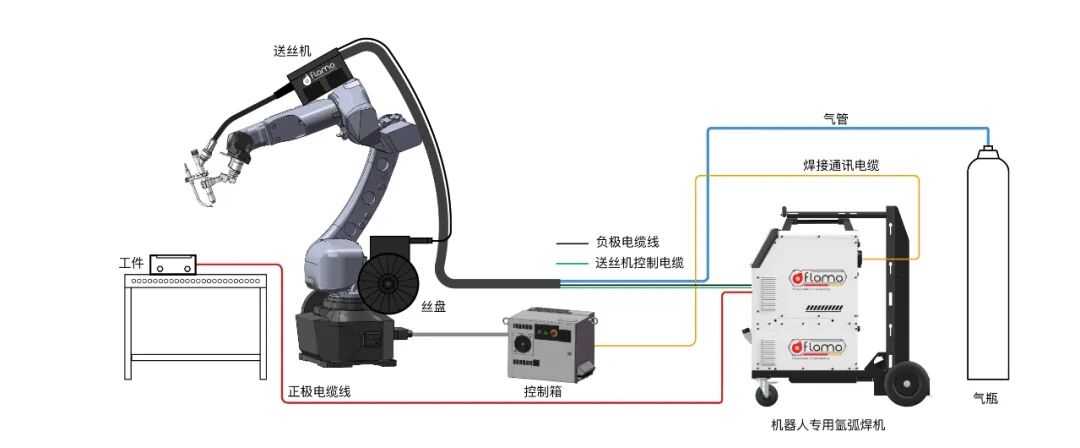
2. Technical Breakthroughs: Solving Core Pain Points and Building a Solid Foundation
To move TIG welding robots from “usable” to “easy to use” and “highly efficient,” the problems above must be addressed at the root.
2.1 Addressing High-Frequency Interference: From “Suppression” to “Elimination”
- Preferred solution: contactless arc-starting technology. Promote designs that physically isolate the arc starter (high-frequency generator) from the robot body, or directly adopt inverter square-wave power sources combined with soft-start arc technologies (such as retract arc starting or high-frequency jacketing), substantially reducing or eliminating high-frequency emission at the source.
- System-level anti-interference design: The robot control system should use fully shielded cables, optimized grounding (single-point grounding), EMI filters on the power input side, and twisted shielded pairs for signal lines. New-generation robot controllers already incorporate stronger electromagnetic compatibility (EMC) design.
- Recommended practice: Build an independent grounding grid for the robot cell, separated from the plant’s main ground. This is one of the lowest-cost yet most effective anti-interference measures.
2.2 Improving Welding Efficiency: Intelligent and Coordinated Optimization
- High-speed rotating TIG technology: A high-speed rotating electrode enlarges the arc heating area, allowing welding speed to be appropriately increased while maintaining penetration depth — particularly suitable for thin-plate seam joining.
- Intelligent parameter coordination: Through digital coordination between the robot and the welding machine (e.g., via fieldbus communication such as Ethernet/IP or PROFINET), welding parameters can be precisely matched and fine-tuned in real time against the robot’s motion trajectory and speed, reducing redundant movements and optimizing the welding takt.
- Twin-wire/hot-wire TIG technology: By adding a preheated wire feeder (hot wire) or feeding two filler wires simultaneously (twin wire), deposition efficiency can be significantly increased (by 50%–100%), with great potential in thick-plate and cladding applications. The robot’s precise wire-feeding control makes this easier to achieve.
2.3 Conquering Process Programming Challenges: Giving Robots the Experience of a “Master Welder”
- Offline programming and simulation: Using professional offline programming and simulation software, welding path planning, reachability analysis, and collision detection are performed based on the workpiece 3D model, integrated with process databases, greatly reducing on-site teach time.
- Laser vision seam finding and tracking: For workpieces with large fit-up errors, laser vision sensors automatically identify seam position, width, and groove, and adjust the robot trajectory in real time to keep the torch centered on the joint.
- Process parameter packages and expert systems: Proven welding parameters (current, voltage, speed, oscillation amplitude, wire feed speed, etc.) for specific materials, thicknesses, and joint types are consolidated into “process packages” that can be invoked with one click. Accumulated data supports the construction of expert systems to assist process development.
- Arc sensing and adaptive control: Exploiting the intrinsic characteristics of the TIG arc (current and voltage change as arc length varies), algorithms enable seam tracking and arc-length adaptive control, reducing cost while improving adaptability.
3. Scenario Breakthroughs: Finding the Right Application Focus for Efficient Deployment
Technology is the foundation; choosing the right application scenarios is the key to success.
3.1 Batch Production with High Added Value and Strict Quality Requirements
- Typical cases: Medical devices (e.g., stainless steel chambers), food machinery, premium kitchenware, nuclear-grade piping, and semiconductor equipment components. These fields demand strict weld cleanliness, bead appearance, and corrosion resistance; labor costs are high and quality fluctuates. The stability and consistency of robotic TIG welding make its value evident here.
3.2 Components with Complex Geometry That Is Difficult to Weld Manually
- Typical cases: Aero-engine ring components, spacecraft fuel tanks, boiler membrane wall tube panels, and complex tubular truss structures. The multi-axis coordinated motion of robots can easily deliver stable welding of various spatial curved seams, solving the problems of high labor intensity and difficult-to-guarantee quality in manual work.
3.3 Welding of Special Materials
- Typical cases: Aluminum alloy vehicle bodies, titanium alloy pressure vessels, and magnesium alloy aerospace components. The robot’s precise heat input control and stable shielding gas environment are ideal for ensuring weld quality of these reactive metals and reducing porosity and distortion.
3.4 Integration with Automated Production Lines
- Integrate TIG welding robots into flexible manufacturing cells (FMC) or automated production lines, combined with positioners, rotary tables, and material handling lines, to achieve automatic clamping, positioning, welding, and unloading of workpieces. This suits the production of components such as automotive exhaust systems and new-energy battery trays.
Conclusion
As technology matures and costs continue to decline, TIG welding robots are gradually breaking through their constraints, moving from a “special forces” role toward a broader “main force” on the production floor. They are not merely a substitute for manual labor, but a key tool for achieving high quality, traceable production, and a leap in manufacturing capability. For enterprises committed to high-end manufacturing, deploying TIG welding robot automation is an important choice for building future core competitiveness.