
Root Causes and Prevention of Lack of Fusion and Incomplete Penetration in Robotic Welding
With the rapid advancement of industrial automation, robotic welding — owing to its high efficiency, high consistency, and high precision — has gradually become one of the core processes in manufacturing. Nevertheless, welding defects can still occur during robotic automated welding, among which lack of fusion and incomplete penetration are two common and typical problems. This article provides an in-depth, professional analysis of the essential differences between the two, their causes, and preventive measures, to help enterprises improve weld quality.
Lack of Fusion and Incomplete Penetration: Phenomena and Essential Differences
1. Lack of Fusion
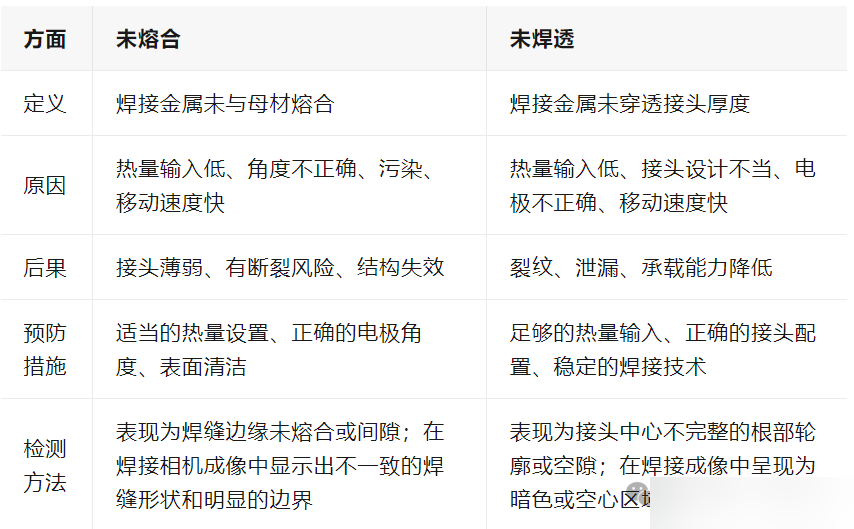
Lack of fusion refers to the incomplete fusion between the weld metal and the base metal, or between a weld bead and an adjacent weld bead. In essence, no effective metallurgical bond is formed at the interface, and it typically occurs at the weld side wall or between layers.
Typical characteristics: the weld surface appears smooth, but obvious delamination or slag entrapment exists internally; ultrasonic testing reveals intermittent reflection signals.
2. Incomplete Penetration
Incomplete penetration refers to the incomplete melting at the weld root, manifested as the weld root failing to form a continuous weld pool with the base metal.
Typical characteristics: unmelted base metal remains at the weld root, and X-ray inspection reveals obvious linear indications at the root.
Key differences:
- Different locations: lack of fusion mostly occurs at the weld side wall or between layers, whereas incomplete penetration is concentrated at the root.
- Different causes: lack of fusion is related to insufficient heat input or arc blow; incomplete penetration is directly related to improper groove design and inappropriate welding parameter selection.
- Different detectability: lack of fusion is more easily overlooked by surface inspection and requires internal flaw detection; incomplete penetration can be preliminarily judged from the root appearance.
Cause Analysis of Defects in Robotic Welding
1. Common Causes of Lack of Fusion
- Insufficient heat input: welding current or voltage set too low, or welding speed too high, leaving the weld pool with insufficient energy to fully fuse the base metal.
- Torch angle deviation: improper torch inclination in robot path programming (e.g., deviation from the weld centerline) causes uneven arc heat distribution.
- Poor groove cleanliness: oil, oxide layers, or rust not thoroughly removed hinders the metallurgical bond between the weld pool and the base metal.
- Multi-pass process defects: improper interpass temperature control, or subsequent passes failing to cover the edges of previous passes.
2. Common Causes of Incomplete Penetration
- Unreasonable groove design: root gap too small, root face too thick, or groove angle insufficient, preventing the weld pool from reaching the root.
- Mismatched welding parameters: current too low, arc too long, or welding speed too high, resulting in insufficient penetration.
- Robot path planning deficiencies: improper torch weaving amplitude or frequency fails to cover the root area.
- Material property effects: high thermal conductivity materials (e.g., aluminum alloys) dissipate heat quickly; without adjusting heat input parameters, incomplete penetration is likely.

Preventive Measures: From Process Optimization to Intelligent Control
1. Precise Matching of Process Parameters
- Dynamic heat input control: adjust current, voltage, and welding speed according to material thickness and thermal conductivity. For example, pulsed welding can be used for thick plates to balance penetration and heat-affected zone.
- Torch attitude optimization: through robot path programming, ensure the torch inclination angle (recommended 10°–15°) aligns with the weld centerline to avoid arc blow.
2. Groove Design and Cleaning Management
- Design groove dimensions in accordance with standards such as ISO 9692, ensuring that the root gap and root face thickness match the process requirements.
- Use mechanical grinding or chemical cleaning to keep the groove and a 20 mm zone around it free of oil and oxide layers.
3. Intelligent Upgrading of Robots
- Real-time sensing feedback: integrate arc tracking and laser vision sensing systems to monitor the weld pool state in real time and automatically correct the welding path.
- Adaptive parameter adjustment: use the digital control features of the welding power source (e.g., the Synergic function) to dynamically compensate for penetration fluctuations caused by workpiece distortion or fit-up errors.

4. Process Monitoring and Quality Assessment
- Online monitoring systems: analyze current-voltage waveforms to identify abnormal arc signals (e.g., abnormal short-circuit frequency) and provide early warning of lack-of-fusion risks.
- Non-destructive testing: combine ultrasonic testing (UT) and phased array ultrasonic testing (PAUT) for life-cycle quality tracking of critical welds.
Conclusion
Defect prevention in robotic automated welding is essentially the coordinated optimization of process parameters, equipment performance, and intelligent control. As a professional manufacturer with years of experience in the welding field, we are committed to helping customers improve weld quality and reduce defect occurrence through high-precision welding power source technology and intelligent welding solutions. In the future, we will continue to explore the digitalization and intelligentization of welding processes to provide the industry with more reliable technical assurance.