
Plasma-MIG Hybrid Welding for Thick Plate
Plasma-MIG hybrid welding — also marketed as SUPER-MIG or SUPER-MAG — combines plasma arc welding (PAW) and gas metal arc welding (MIG/MAG) into a single welding process. The plasma arc supplies energy density and keyhole penetration; the MIG/MAG arc supplies filler metal at high deposition rate. The combination does something neither process does alone: it welds thick plate from one side, without a groove, and forms a bead on both faces.
That single capability is the reason the process matters commercially. Groove preparation, back-gouging, multi-pass filling and slag removal are the four cost centres in conventional thick-plate welding. Removing them changes the economics of a joint more than any improvement in travel speed.
Technical Principle of SuperMIG Welding
The two arcs are not simply placed side by side. The plasma arc is established at the leading edge of the weld and forms a keyhole in the base material. The MIG/MAG arc then interacts with it electromagnetically: current in the MIG arc sets up a field that pulls the plasma arc forward toward the front of the weld pool. That forward deflection stiffens the plasma arc and stabilises it, which is what allows the keyhole to be held at higher travel speeds than a free plasma arc of the same power.
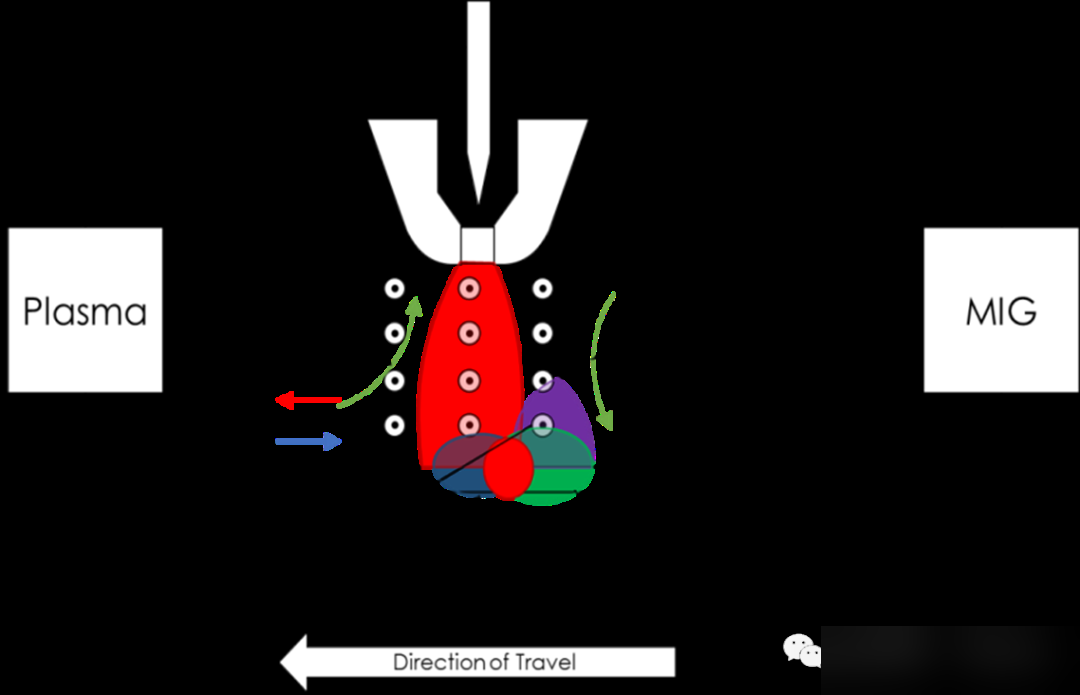
Three things then happen at once inside a single process window: the keyhole opens the full plate thickness, the filler wire fills it from the top, and the molten metal bridges to form a root bead on the underside. The parameter set that holds this stable — plasma current, MIG current, wire feed, travel speed, stand-off and gas flow — is narrow, which is the main reason the process demands a properly qualified procedure rather than trial-and-error setup.
Ignition and Metal Transfer Sequence
The start of the weld decides whether the rest of the pass is sound. The sequence runs in a fixed order, and skipping a step leaves a root defect at the start of the seam.
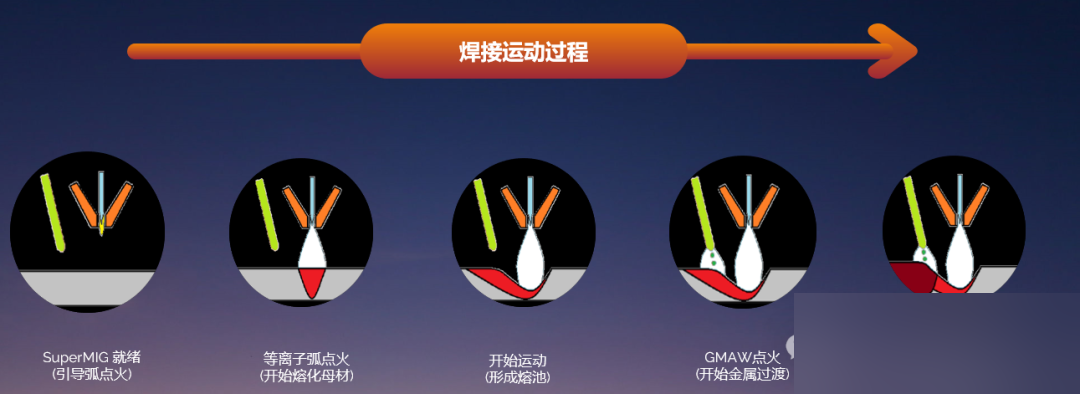
- Pilot arc establishes position. A low-current pilot arc between wire and workpiece locates the wire tip precisely before full power is applied, so the start point is repeatable.
- Plasma arc ignites and melts the parent metal. Full plasma current opens the keyhole through the section.
- Travel begins and the weld pool forms. The head moves, the pool extends forward, and the keyhole becomes a moving cavity.
- MIG/GMAW transfer starts. Filler metal begins transferring as droplets into the pool, filling the cavity behind the keyhole.
- Steady state. Keyhole, transfer and solidification reach equilibrium — the window that has to be held for the whole seam.
The critical transition is step 4. If filler transfer begins before the keyhole is fully open, the root is unfused; if travel starts before the pool is stable, the start of the seam is porous.
Weld Test Specimens: Welded Without Groove Preparation
The claim that carries most weight is that these joints were welded on square-edged plate — no bevel, no machined root face, no back-gouging.
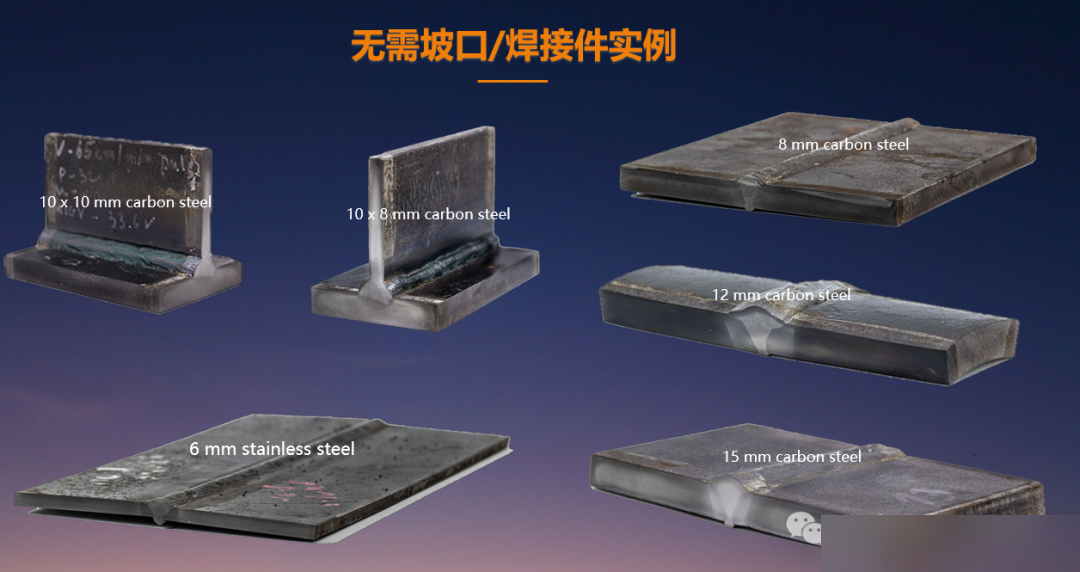
Specimens from the process development programme:
| Joint type | Material | Thickness |
|---|---|---|
| T-joint | Carbon steel | 10 × 10 mm |
| Corner joint | Carbon steel | 10 × 8 mm |
| Butt joint | Carbon steel | 8 mm |
| Butt joint | Carbon steel | 12 mm |
| Butt joint | Carbon steel | 15 mm |
| Butt joint | Stainless steel | 6 mm |
The stainless specimen is the interesting one. On austenitic stainless, welding without groove preparation removes a whole sequence of oxide and contamination risks — the square edge only has to be clean, not machined to a profile.
Advantages of SuperMIG Welding
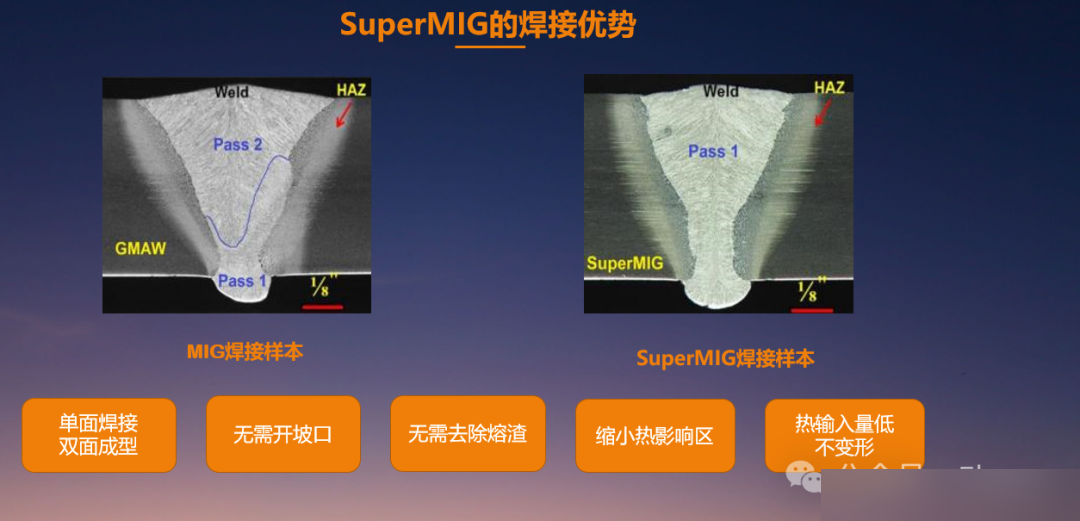
The cross-sections above make the comparison concrete: on one side, a conventional GMAW joint welded with two passes, one from each side, on grooved plate; on the other, a SUPER-MIG joint welded with a single pass from one side on square-edged plate, reaching equivalent penetration.
Five consequences follow:
- Single-sided welding, double-sided formation. One pass from one side produces a root bead on the far face. No turning of the workpiece, no back-gouging, no second setup.
- No groove preparation. Square edges are cut and welded. This removes the beveling operation — and on alloy and stainless plate, removes the machining step that would otherwise be needed to avoid thermal edge damage.
- No slag to remove. This is not a flux process, so there is no slag line to chip and no flux to recover. Between passes there is nothing to clean.
- Narrower heat-affected zone. Higher energy density and faster travel put less total heat into the plate, so the HAZ is narrower than an equivalent multi-pass GMAW joint.
- Lower heat input, less distortion. Less heat in the plate means less shrinkage and less angular distortion — the difference between a panel that needs straightening and one that does not.
Where the Cost Saving Comes From
The saving is not in welding speed alone. On a thick-plate joint the conventional route is: cut the plate, machine or flame-cut a bevel, fit up with a root gap, weld the root, back-gouge, weld the fill passes, clean between passes, and straighten afterwards. Every step is a handling operation with its own labour, floor space and inspection cost.
SUPER-MIG removes the bevel, the back-gouging, the between-pass cleaning and, on many joints, the straightening. The welding itself is faster, but the larger part of the saving is the operations that no longer exist. The trade-off is equipment cost and process discipline: the power source is more complex than a standard MIG set, and the procedure has to be qualified and held rather than adjusted by the operator.
Limitations Worth Stating Plainly
- Thickness window. The specimen range here runs to about 15 mm on carbon steel in a single pass. Beyond that the joint needs preparation, or the process has to be treated as a multi-pass variant — it is not a universal replacement for electro-slag or narrow-gap submerged arc on very heavy sections.
- Fit-up sensitivity. A keyhole process needs consistent fit-up. Gaps that open or close along the seam change the keyhole and produce root defects, so clamping discipline matters more than on a grooved joint.
- Procedure qualification. The process window is narrow enough that a qualified WPS and trained operators are prerequisites. This is the honest reason many buyers who trial the process never adopt it in production.
Conclusion
Plasma-MIG hybrid welding earns its place on joints where groove preparation, back-gouging and multi-pass filling dominate the cost — thick plate in pressure equipment and structural fabrication, and stainless or alloy work where a machined edge is expensive. It is not a general-purpose replacement for MIG/MAG, and it is not a substitute for qualified procedure development.
The useful starting point is a specific joint: plate thickness and material, joint type, the applicable welding procedure specification, and the inspection standard the finished weld must meet.
DESAN ELECTRIC supplies welding equipment and positioning systems across positioners, turning rolls, manipulators, H-beam lines and robot cells. Minimum order quantity for equipment is 1 set; standard machines ship in 30–50 days after deposit. Payment terms are T/T and trade terms are FOB, FCA or CIF. DESAN ELECTRIC LTD has served 1,000+ customers in 20+ countries over 20+ years, with welding engineering experience dating from 1997.