
High-Capacity Floor Turntables with 360° Variable-Speed Rotation
HT450 Heavy-Duty Welding Positioner — 8-Arm Rotary Table
The HT450 is a floor turntable built for workpieces that will not fit on a conventional positioner: a rated load of 450 t, a transient overload capacity of 500 t, and an eight-arm star structure that carries the load out to a Φ13,000 mm working diameter around a Φ3,800 mm central table. Rotation is driven by a servo system over 0.002 – 0.2 rpm, infinitely variable, so the same machine can index a 400-tonne vessel head in a few minutes and then hold a controlled 360° rotation under the arc at welding speed.
It is a pure rotary machine — no tilt axis, no lift column. Height is fixed at 1,600 mm, which is what makes it practical: the workpiece is set down once on the arms and then rotated under the torch, instead of being craned and re-slung for every seam.
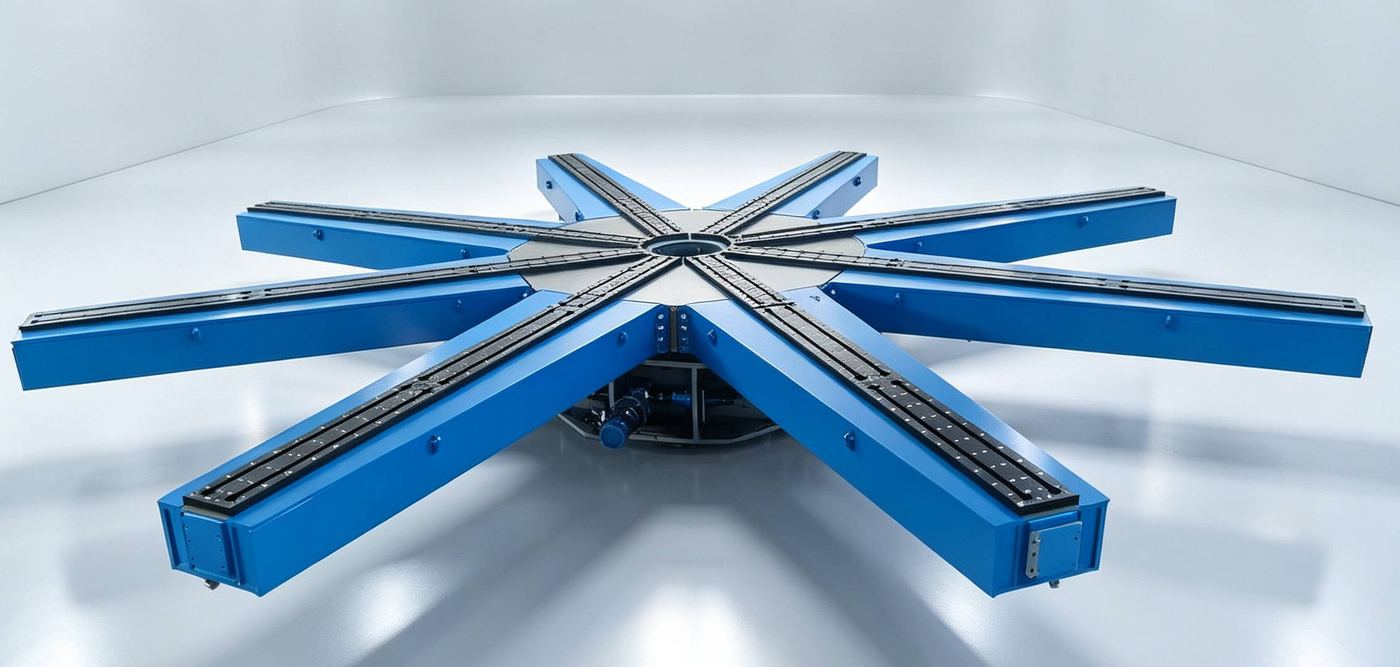
HT450 heavy-duty welding positioner: eight radial arms, Φ13,000 mm working diameter, 450 t rated load.
What makes it a floor turntable
A floor turntable is defined by where the load path runs. On a headstock positioner the entire workpiece hangs on one bearing housing and one tilting head; the table is small relative to the part, and a heavy eccentric load translates straight into a large overturning moment. On the HT450 the load is distributed across eight radial arms at 45° intervals, each of them landed on an adjustable support footpad, and the central octagonal base carries only the rotation. The machine stands on the workshop floor with a compact footprint and minimal foundation requirement — no pit, no trench, no special civil works.
That is also the trade-off. This class of machine does not tilt, so it is right for circumferential seams, flange rings, disc-shaped parts, large annular components and any rotationally symmetric fabrication that can be welded in the flat or horizontal-vertical position. If the joint has to be brought to flat by tilting as well as rotating, a WP or EWP series positioner of the appropriate capacity is the correct machine — the two families are complementary, not alternatives.
450 tonnes rated, 500 tonnes transient — why the margin is not marketing
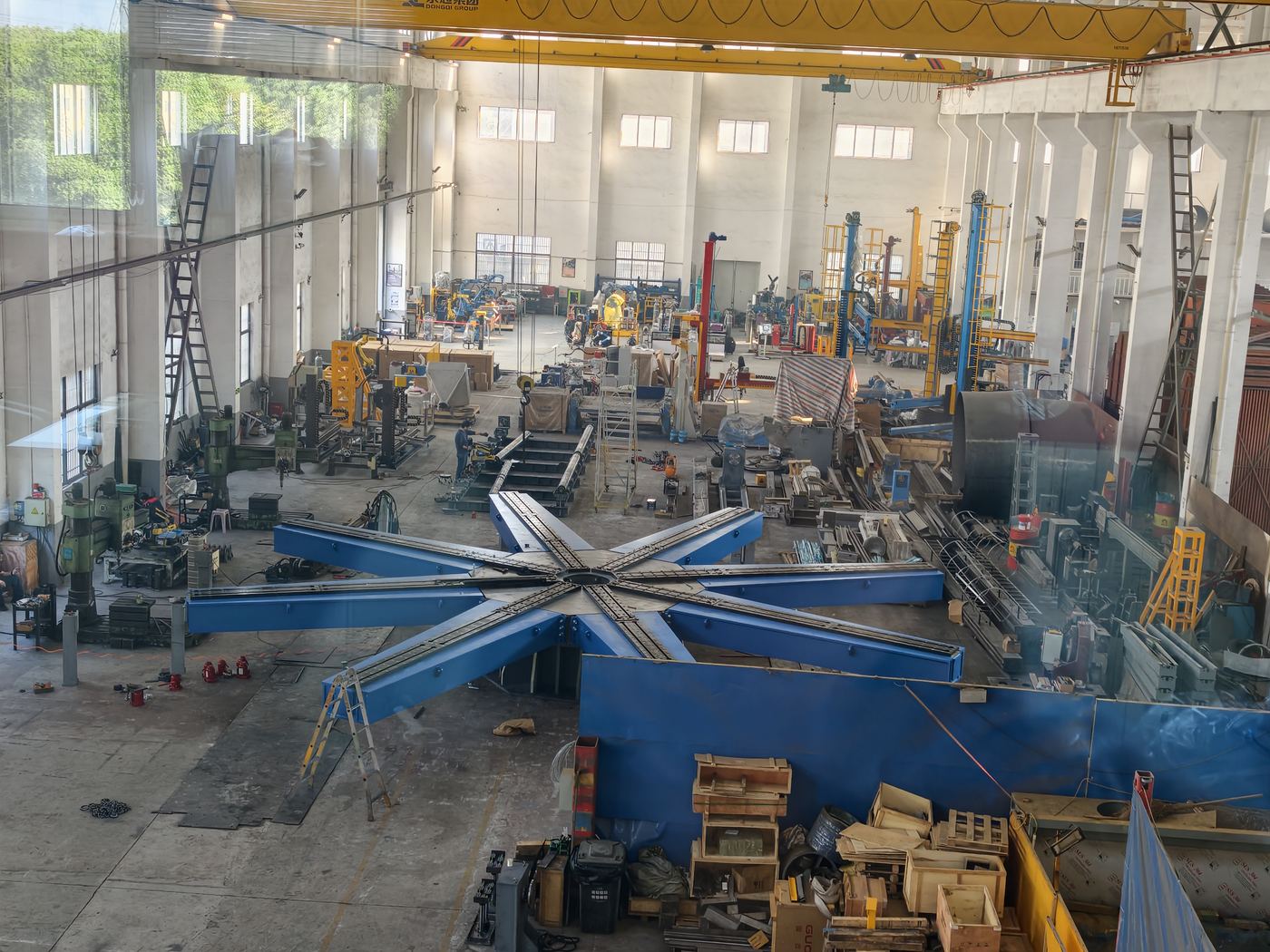
HT450 in production: the 8-arm turntable set into an existing heavy fabrication bay, with the surrounding 450 t class handling equipment.
A rated capacity is a steady-state figure: the load sits on the table, the table rotates, nothing accelerates. The transient figure covers everything else that happens in a real shop — the crane setting the workpiece down slightly off-centre, the impact of a hard landing, a fixture being dragged into position, and the thermal movement of a large weldment as it cools between passes. A 50-tonne margin on a 450-tonne machine is roughly 11%, and it is the reason the structure can absorb those events without the drive train seeing them.
The structural argument matters as much as the number. An octagonal central base plus eight evenly spaced arms gives uniform load distribution and high torsional rigidity, and the support arrangement is a composite of central drive plus peripheral support — the centre drives rotation, the arm ends carry the load. That separation is what keeps rotation accuracy stable when the table is fully loaded, rather than depending on a single large-diameter bearing to do both jobs.
360° variable-speed rotation: what 0.002 rpm actually buys you
Rotation speed on a large turntable is usually quoted in rpm, which is almost meaningless on its own, because what the weld sees is surface speed at the joint radius. At the Φ13,000 mm outer diameter one revolution is 40.84 m of travel:
| Rotation speed | Surface speed at Φ13,000 mm | Typical use |
|---|---|---|
| 0.002 rpm | 82 mm/min | Slow submerged-arc passes on very large rings |
| 0.01 rpm | 408 mm/min | Standard SAW circumferential welding |
| 0.02 rpm | 817 mm/min | Fast SAW / high-deposition capping |
| 0.2 rpm | 8.17 m/min | Indexing between stations, no welding |
A submerged-arc circumferential weld typically runs at 300–800 mm/min. On a 13-metre workpiece that means 0.007 – 0.02 rpm, right at the bottom of the range — which is exactly where most turntables cannot hold a steady speed. Servo drive with high low-speed torque is the point of the specification: the table has to turn smoothly at a few hundredths of a revolution per minute without stick-slip, because any crawling shows up directly as weld ripple and inconsistent penetration.
The top of the range is not wasted either. 0.2 rpm makes the table a positioning device as well as a welding device: a 180° index takes 2.5 minutes instead of half an hour, which matters when a part has eight seams on eight arms.
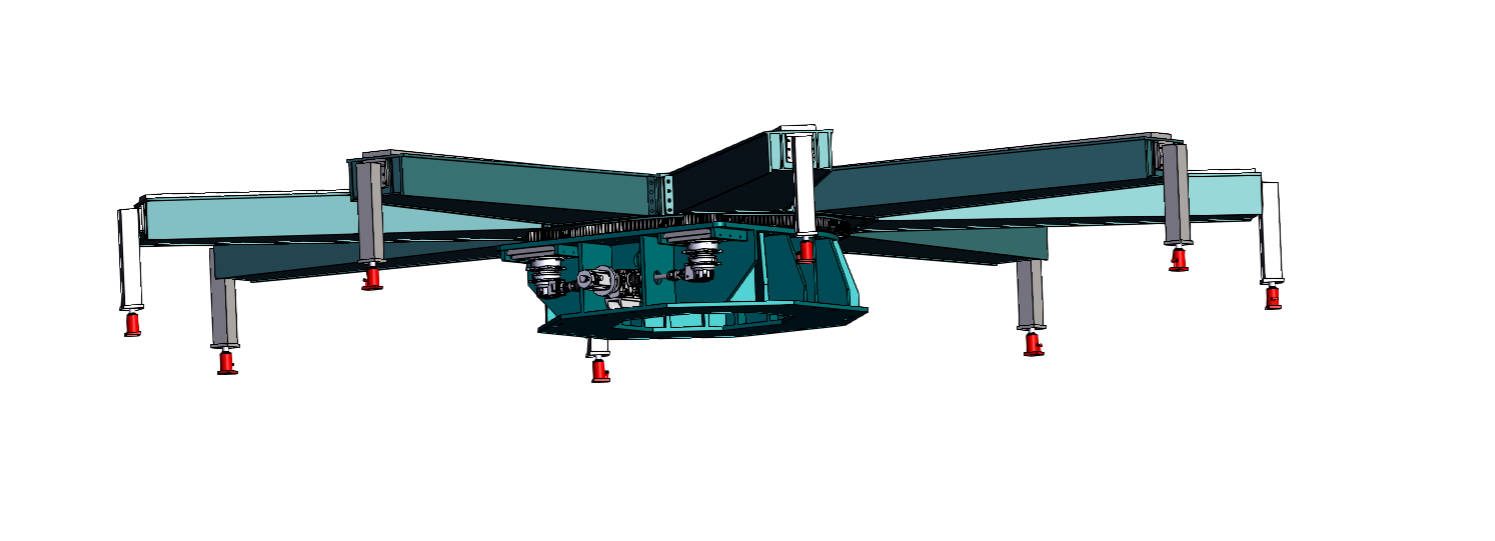
Structure: octagonal central rotary base, eight radial arms at 45°, T-slot mounting rails along each arm.
Technical specifications
| Parameter | Specification |
|---|---|
| Rated load capacity | 450 t |
| Transient load capacity | 500 t |
| Rotary speed range | 0.002 – 0.2 rpm, infinitely variable |
| Speed control | Servo motor drive |
| Drive motor power | 11 – 15 kW, selected per application |
| Table height | 1,600 mm |
| Central table diameter | Φ3,800 mm |
| Extended arm diameter | Φ13,000 mm (8 arms, 45° spacing) |
| Mounting interface | T-slot rails on each arm |
| Levelling | Adjustable support footpad at each arm end |
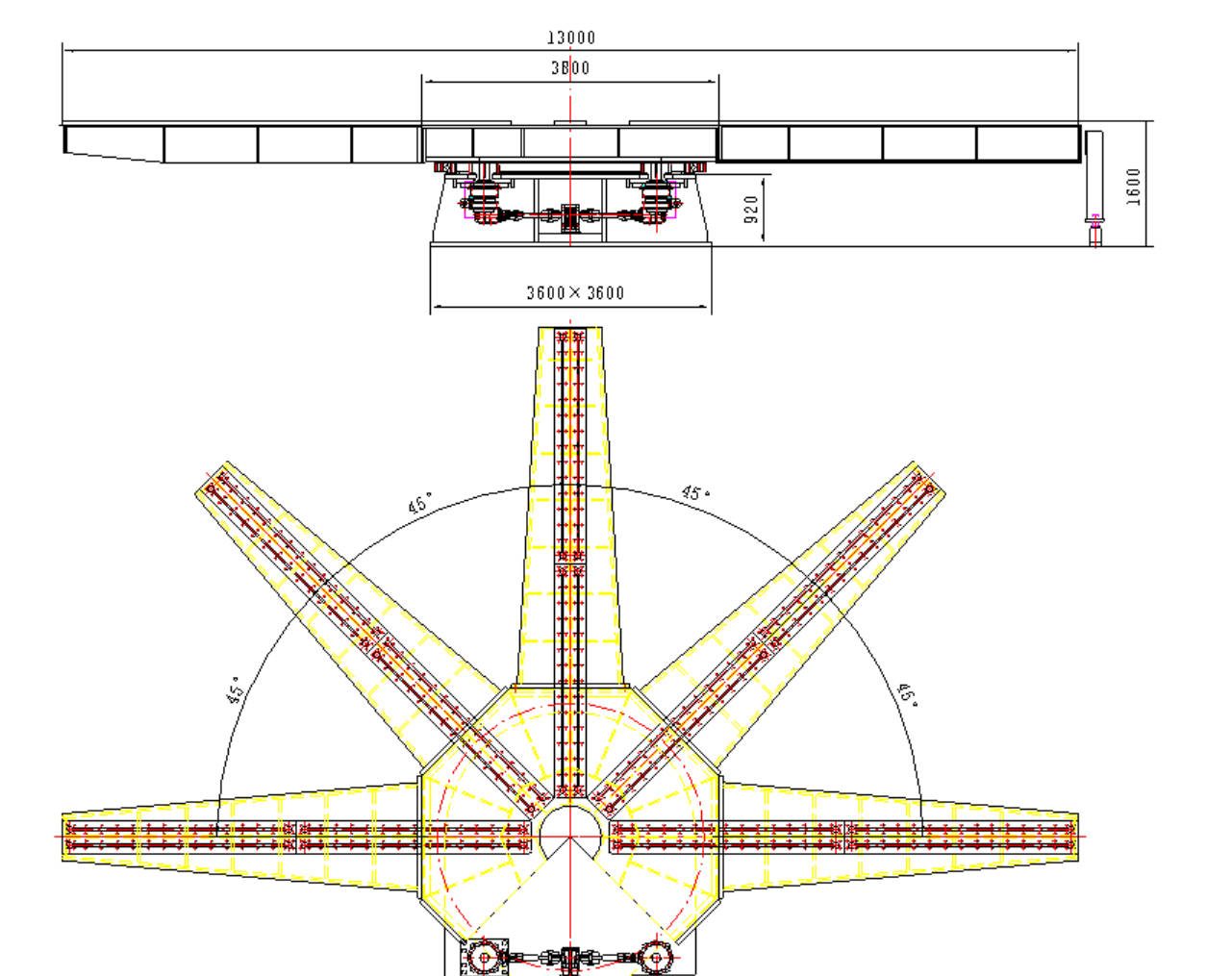
Dimensional drawing: 3,600 × 3,600 mm central rotating section, 13,000 mm overall arm span, 1,600 mm table height.
The 1,600 mm table height is an ergonomic choice as much as a structural one. It puts the joint at roughly waist height for a standing welder working with a semi-automatic torch, so circumferential seams are welded without stooping and without the neck strain of working overhead. For a robotic cell it is a convenient mounting plane for the fixture stack.
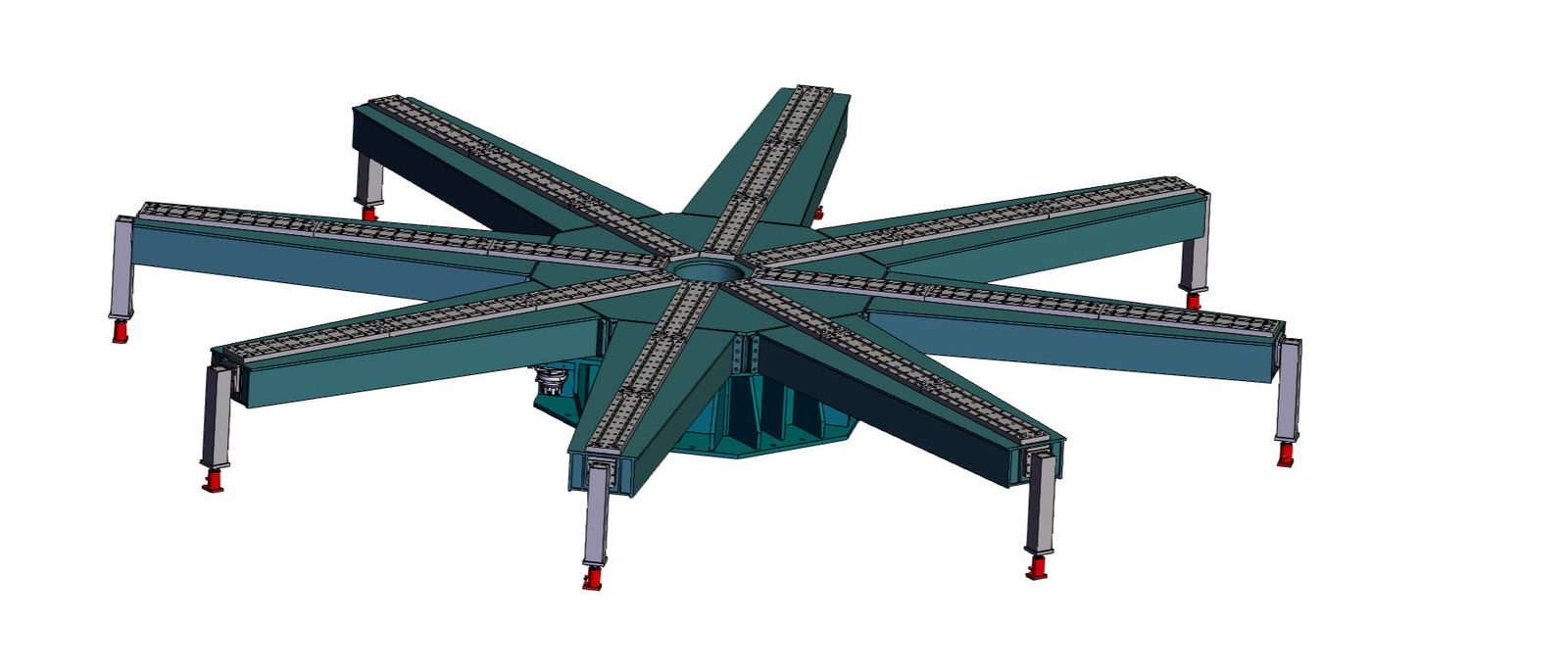
Plan view of the eight-arm layout: 45° spacing, T-slot rails for fixture and tooling installation on every arm.
Typical applications
- Pressure vessels and large storage tanks — circumferential and longitudinal seam positioning on shells beyond the capacity of a headstock positioner
- Wind energy — tower flange welding, hub rotary positioning, bearing housing fabrication
- Heavy machinery — large structural frames, bases and assembly tooling
- Shipbuilding and offshore — large sections, flange and pipe circumferential welding
- Nuclear and chemical equipment — reactor, heat exchanger and column shell welding platforms
- Pipe and flange industry — large flange welding, pipe circumferential welding machines
- Robotic welding integration — the turntable acting as the external rotary axis of a robot station, with the fixture mounted on the arms
Specifying a turntable for your workpiece
Three numbers decide the configuration: the mass of the heaviest assembly (including fixture), the outer diameter the workpiece sweeps, and the welding process and travel speed required at the joint. From those, the arm span, the drive motor rating and the speed range follow. Workpieces that are heavy but small sit on the Φ3,800 mm central table; workpieces that are large but light are carried on the arm ends, where the load path is longer and the support footpads take the weight.
Send the workpiece drawing with the weld map and our engineering team will confirm the load case, the arm layout and the fixture interface before quoting. Standard machines are quoted at MOQ 1 set, 30–50 days after deposit for standard models, T/T, FOB / FCA / CIF. Positioners in the HT series are covered by a CE certificate of compliance — test reports available on request.
Related equipment: welding positioners, welding turning rolls for the cylindrical shells that usually accompany a turntable this size, and boom and column manipulators for the welding head. Or send us your workpiece details for a configuration and a quotation.