

Fit-up is a separate operation, and it needs its own machine
On a wind tower line, welding a circumferential butt joint is the easy part. The difficult part is getting two 4 m diameter cans to meet with the right root gap, the right hi-lo (radial mismatch) and the right ovality, and holding them there while the root pass is made. That is the fit-up operation, and it is where most tower line cycle time and most repair work originates.
The WR600F is a fit-up rotator: a rotator whose job is alignment first and rotation second. It brings the two cans together, adjusts them radially and axially against each other, and then turns the aligned pair together so the root and fill passes can be welded in one continuous cycle.
What a fit-up rotator has to do that a plain rotator cannot
| Function | Plain turning rolls | Fit-up rotator |
|---|---|---|
| Support and rotate the workpiece | Yes | Yes |
| Correct radial mismatch at the joint | No — mismatch stays as rolled | Yes — powered radial adjustment |
| Control root gap around the circumference | No — gap is whatever the can ends give | Yes — axial adjustment closes or opens the gap |
| Hold both cans as one rotating body | Only if they are already aligned and tacked | Yes — alignment is maintained through rotation |
| Accept out-of-round can ends | No | Yes — corrected at the joint, where it matters |
That last row is the one that decides quality. Rolled tower cans are never perfectly round; the ovality is at the ends where the rolling operation leaves residual curvature. A plain rotator transfers that ovality straight into the joint, and the welder then fights a root gap that opens and closes as the can turns. A fit-up rotator corrects the shape locally at the joint, which is the only place the tolerance is measured.
Why this matters on the tower line specifically
Tower joints are full-penetration butt welds, normally ultrasonically inspected, on a structure that has to bolt together on site. Three failure modes trace directly back to fit-up:
- Hi-lo beyond limit — the step between the two can surfaces. Excessive hi-lo produces lack of sidewall fusion at the root, which is exactly what UT finds and what requires gouging out and re-welding.
- Root gap variation — a gap that opens during the pass burns through; a gap that closes leaves incomplete penetration. Neither is recoverable after the pass.
- Ovality carried downstream — a section that leaves the line out of round will not accept the next can or the flange, and by then the tower is welded, inspected and possibly coated.
How the machine works in the line
The fit-up rotator sits between the can preparation station and the welding station. Cans are set into the machine, the trailing can is brought axially to the leading can until the root gap is correct, radial adjustment is used to bring the mismatch within tolerance, and the pair is then rotated while the column-and-boom machine welds. In a multi-station line the fit-up unit is often the pacing station — it sets how many sections per shift the whole line produces, because the welding stations can only work on what has been fitted up.
Specifying a WR600F
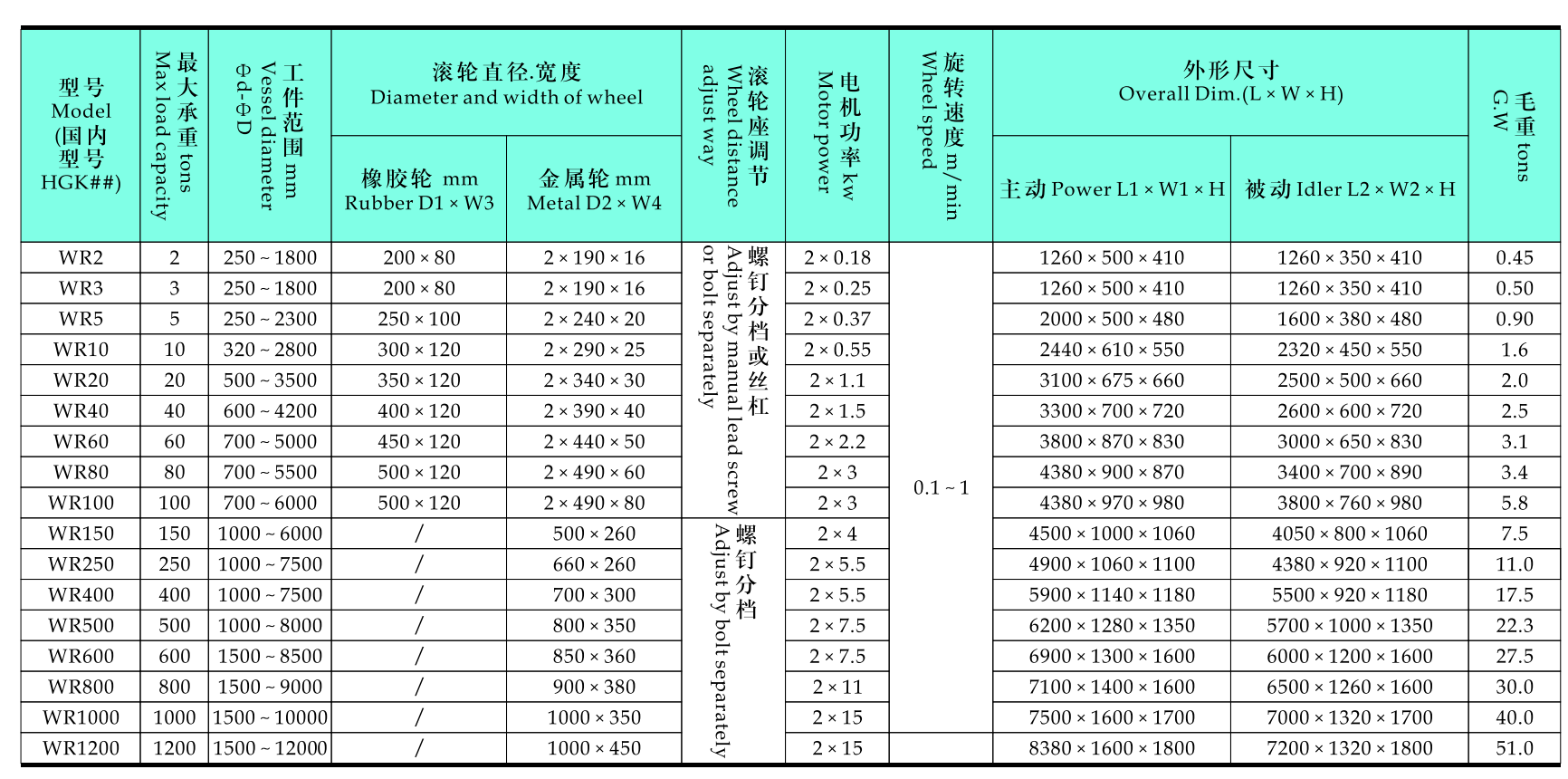
To quote a fit-up rotator we need: tower diameter range (base and top), can length and weight, wall thickness and material, the fit-up tolerances the inspection standard requires (hi-lo and root gap limits), the welding process for the root pass, whether the machine sits in a single-station or multi-station line, the required cycle time in sections per shift, and the available floor length and crane capacity. On existing lines we also need the interface dimensions to the adjacent stations.
Fit-up rotators are built to the line rather than supplied from stock, so the proposal normally covers the machine, the alignment arrangement and the interface to the rest of the line. Minimum order quantity is 1 set. Equipment ships in 30–50 days after deposit for standard configurations; integrated line packages are scheduled in the technical proposal. Payment terms are T/T; trade terms are FOB, FCA or CIF. Core ranges are CE compliant and supplied against a certificate of compliance.
Rotators and turning rolls are supplied under the DESAN brand, positioners under BIQEE and combination welding machines under ZAULUX, contracted by DESAN ELECTRIC LTD — 1,000+ customers in 20+ countries across 20+ years, with welding engineering experience since 1997. For the complete plant layout see wind tower butt welding and fit-up lines; for chain-drive rotation on coated sections see the CWR20 chain rotator.