

Electro-slag welding: one pass through thick plate, not fifty
Electro-slag welding (ESW) is the process of choice when a joint is too thick for multi-pass arc welding to be economical. Instead of laying bead on bead through a 100 mm section, ESW builds a molten slag pool that travels up the joint and deposits the whole thickness in a single, continuous pass. The weld metal solidifies behind the pool as it climbs, so a 200 mm butt joint is finished in one cycle rather than forty or fifty.
That single characteristic — thick section, one pass, no edge preparation — is why the process dominates box columns, heavy press frames, ship structures and large machine bases. On a 460 mm wide box column web, electroslag welding reduces a shift's worth of manual work to a controlled, monitored cycle.
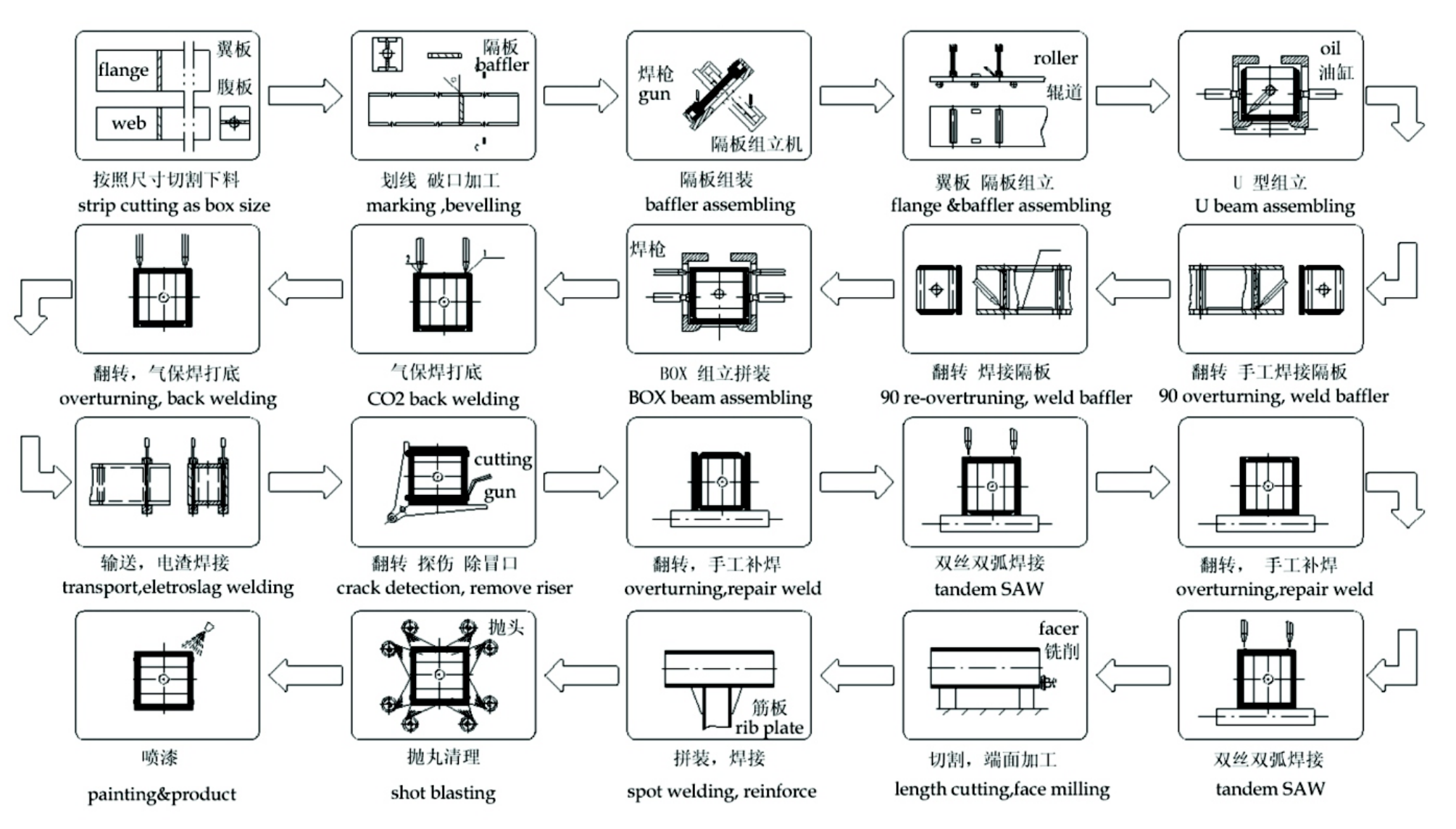
How the XD12 works
1. Copper shoes form the weld pool
Water-cooled copper shoes clamp to both faces of the joint and act as a moving mould. The shoes travel upward with the welding head, containing the molten slag and metal so the joint is welded full-penetration without backing bars, without root gaps and without back-gouging. Shoe pressure, cooling water flow and travel speed are the three parameters that decide whether the weld surface comes out clean or rippled — on the XD12 they are set from a single control panel and held through the pass.
2. Wire feed, oscillation and slag pool depth
Filler wire is fed into the slag pool from one or more heads. The pool itself provides the resistive heating that melts the wire, which means the plate edges are melted by the slag, not by the arc — the defining difference from gas-shielded or submerged-arc welding. Wire oscillation across the joint thickness keeps the pool flat and the fusion line even on sections above about 100 mm. Slag depth is regulated by the operator and is the primary control over penetration consistency; too shallow and the fusion line becomes irregular, too deep and the pool destabilises.
3. Vertical or inclined travel
The head climbs a guide rail or a column-mounted mast, following the joint line. Vertical and inclined joints are both supported, which is what allows the process to be used on the vertical web of a box column rather than only on flat work. Travel speed is matched to plate thickness and wire feed rate so the pool stays at constant depth from start to stop.
Process comparison: where ESW wins and where it does not
| Process | Typical plate thickness | Passes for 100 mm | Edge preparation | Best application |
|---|---|---|---|---|
| Electro-slag welding (ESW) | 40–300 mm | 1 | Square edge, no bevel | Box columns, heavy frames, ship structure |
| Submerged arc welding (SAW) | 6–60 mm per pass | 8–20 | V, X or U groove | Long straight seams at high deposition |
| Gas metal arc (MIG/MAG) | 2–20 mm | 20–40 | V groove | Thin to medium sections, robot cells |
| Electro-gas welding (EGW) | 10–40 mm | 1–2 | Square or slight V | Vertical seams in moderate thickness |
The trade-off is heat input. ESW puts a large amount of energy into a narrow band, so the heat-affected zone is wide and the weld metal and HAZ are coarse-grained as-welded. On structural work this is normally handled by selecting a suitable material grade, by normalising after welding where the specification demands it, and by controlling the start and stop positions so run-on and run-off plates absorb the defects that form at each end of the pass. For applications where the specification forbids the as-welded coarse grain, ESW is the wrong process — and it is better to say so at the quotation stage than on site.
Where XD12 machines are used
- Box columns and box beams — the internal web-to-flange joints of large welded box sections, where access for arc welding is limited but a copper shoe can be clamped to both faces.
- Heavy structural and bridge fabrication — thick flange splices and diaphragm connections where the joint is square-edged and vertical.
- Shipbuilding and offshore — vertical seams in hull blocks and heavy brackets.
- Press frames, machine bases and mill housings — thick plate assemblies where the section is too heavy for economic multi-pass work.
What a working system needs
An ESW installation is a system, not a single head. Around the XD12 head you need: a travel column or rail rigid enough not to deflect as the head climbs; water cooling for shoes with enough flow and temperature monitoring to avoid a shoe burn-through; flux or slag starter for the initial pool; run-on and run-off plates at both ends; and a welding power source sized for the wire feed rate the thickness demands. Mechanical restraint of the joint during the pass also matters — the shrinkage forces in a 200 mm electroslag weld are large, and fixture design decides whether the finished box springs out of tolerance.
Power source of the XD12 station
The XD12 station runs on two Lincoln DC-600 power sources, and that detail is worth stating because it is the part of an electro-slag specification that people underestimate. Deposition rate on an electro-slag head is limited by available current at duty; a single 600 A source will weld a thin box web, and will not hold a production travel speed through a thick web in one pass. Twin sources in parallel are what make the single-pass claim realistic on the sections this machine is sold for.
The station itself is a travelling column frame carrying the vertical head, with the box fed in on rollgangs from the assembly station. A clearance is deliberately left between baffle and box during assembly so the baffle can be positioned; the XD12 then welds that clearance closed. This is a good example of why a box beam line has to be specified as a line — the assembly tolerance at station four is set by what station five can close.
Specifying an XD12 for your joint
Electroslag welding is specified from the joint, not from a catalogue. To quote an XD12 configuration we need: plate thickness and material grade, joint type and whether the weld is vertical or inclined, the length of the pass, the section geometry (how much access exists for shoes), and the relevant welding procedure specification or standard the finished weld must satisfy. Send the drawing and the specification and we will come back with the head configuration, shoe design, power source and travel system as one package.
Minimum order quantity is 1 set; custom and turnkey box-column production lines are quoted per project. Standard configurations ship in 30–50 days after deposit. Payment terms are T/T, and trade terms are FOB, FCA or CIF. All DESAN ELECTRIC equipment is supplied against a certificate of compliance and is CE compliant for the core range.
DESAN ELECTRIC has supplied welding positioning equipment to 1,000+ customers in 20+ countries over 20+ years, with an engineering team working on welding equipment since 1997. Electro-slag and heavy-section welding machines are supplied under the ZAULUX combination-welding brand; the enquiry, quotation and contract are handled by DESAN ELECTRIC LTD.