
Capability Limits of Teach-Free Fully Automatic Welding Robots
As the waves of “Industry 4.0” and “smart manufacturing” sweep in, welding robots — as the vanguard of automation transformation — have been pushed to the forefront. The market is flooded with dazzling slogans: “replacing manual labor,” “zero-defect quality,” “AI-empowered,” “doubled efficiency”… However, when you consider bringing this “new employee” into your factory, are you hearing marketing talk or the real truth? Today, setting aside flowery rhetoric, we want to talk with you about the four most realistic truths about welding robots at the current stage.
Reality 1: Will Intelligent Welding Robots Replace Welders?
No! But people who know how to operate intelligent welding robots will replace those who do not.
This is a fundamental shift in mindset. A welding robot is not a “Terminator” but a powerful production tool. It cannot program itself, fixture itself, or maintain itself. It needs a “commander” who understands welding processes and knows how to operate robots.
This “commander” — the robot operator or programmer — will become a scarce talent in the new era. He not only knows how to make the robot move, but also how to adjust parameters when deviations occur and how to optimize paths to improve efficiency.
Key takeaway: Introducing robots is essentially an upgrade of your team. What you invest in is not only equipment, but also the empowerment of people. Your existing skilled welders, after training, are the most likely candidates to become this “commander.” This is not a simple job replacement, but an elevation of skills and value.
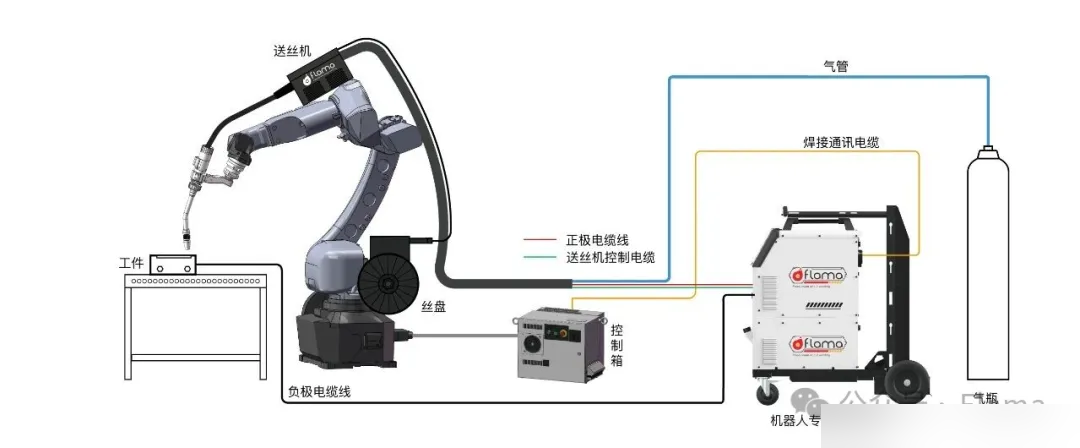
The figure below shows a basic welding robot workcell: gas metal arc welding (GMAW) robot.
Reality 2: Do Intelligent Welding Robots Guarantee Weld Quality?
No! It is only a precise “executing arm”; the “brain” of the process is still human.
A welding robot is an extremely faithful executor. It moves as fast as you tell it to; it outputs exactly the current and voltage you set. But why should the speed and parameters be set this way? That depends on authoritative welding process expertise.
Whether a weld is acceptable depends on the welding procedure. How is the groove prepared? What gas and what wire are used? How is interpass temperature controlled? These core process specifications must be defined by experienced welding engineers. The robot simply replicates the procedure faithfully and tirelessly. If the procedure itself is wrong, the robot will only “make the best of a bad job” and efficiently produce large quantities of defective parts.
Key takeaway: Do not expect robots to solve all welding quality problems. What you need is the combination of “welding expert wisdom + precise robot execution.” Before introducing a robot, make sure you have, or have access to, a mature welding procedure system.
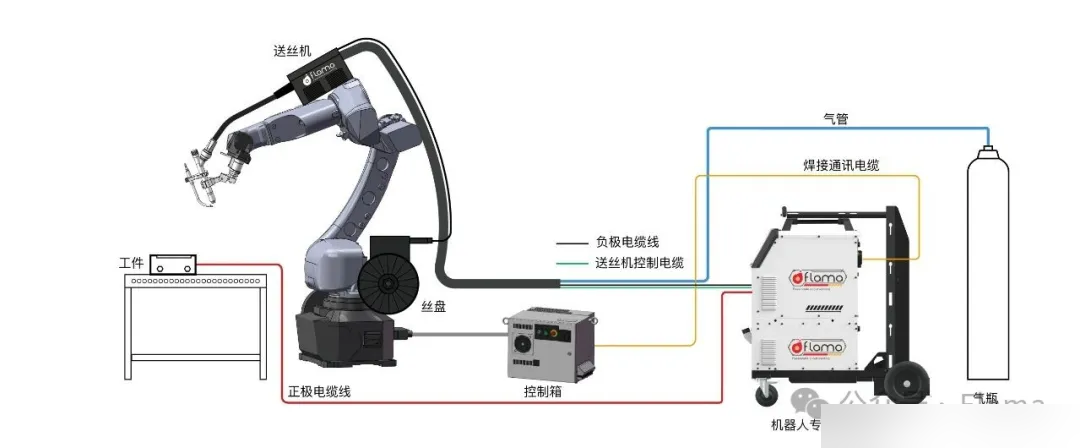
The figure below shows a basic welding robot workcell: TIG (GTAW) argon arc welding robot.
Reality 3: Do Intelligent Welding Robots Actually Have AI?
No! Real AI welding is a trend, but the current mainstream is “physical intelligence.”
The word “AI” is being overused these days. For the vast majority of so-called “intelligent welding robots” on the market, the “intelligence” lies in sensors such as laser vision and arc sensing, which perceive the weld position in real time and correct deviations to achieve adaptive welding.
This is advanced, but it falls into the category of “physical intelligence” or “perceptual intelligence.” It executes a preset program with feedback adjustment.
True AI welding, by contrast, is based on massive welding data, using deep learning to self-optimize unprecedented, better welding parameters. This requires a long and expensive process of data accumulation and algorithm training; it is still in the exploration and early application stage and has not yet become an accessible technology.
Key takeaway: Do not pay a high premium for the “fake AI” concept. Focus on whether the robot has practical functions that meet your product needs, such as real-time tracking and adaptive adjustment — that is the most cost-effective “intelligence” available today.
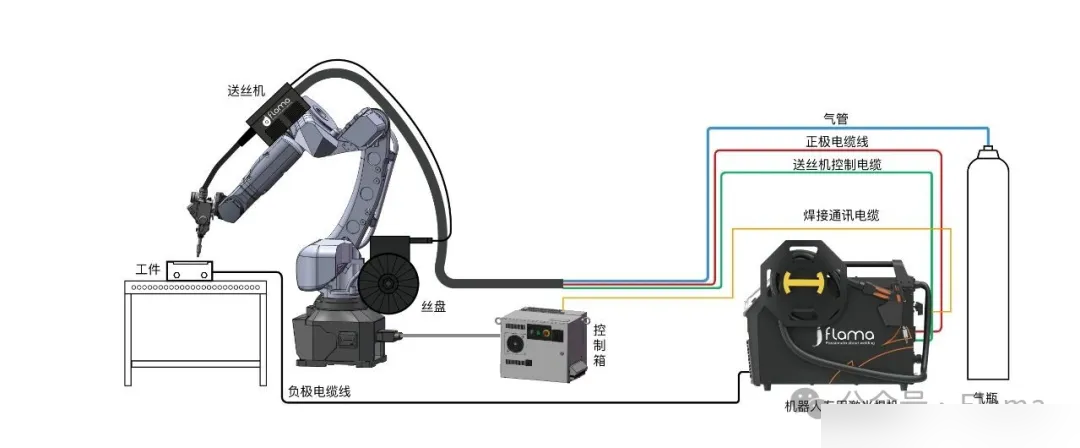
The figure below shows a basic welding robot workcell: one-knob laser welding robot.
Reality 4: Are Intelligent Welding Robots Always More Efficient Than Welders?
Not necessarily per unit time for a single weld joint! But they hold a clear advantage in overall production efficiency and quality consistency!
We must admit that for a simple, single weld, a skilled welder who picks up the torch and starts welding is indeed faster than a robot, which requires a series of preparations such as programming, fixturing, and positioning.
But please shift your view from “a single point” to “the whole picture”:
- Quality consistency: The robot never tires. The parameters, speed, and posture of the 1st weld and the 1000th weld are exactly the same, effectively avoiding the quality fluctuations and defects caused by human fatigue and mood swings.
- Long-duration operation: A person can work continuously for 8 hours, but a robot can work 24 hours nonstop (with an appropriate loading/unloading system), greatly improving equipment utilization and throughput.
- Overall efficiency: For batch products, once the first part is programmed and commissioned, subsequent welding time is compressed to a minimum, and the overall production cycle is greatly shortened.
Key takeaway: When evaluating robot efficiency, do not just watch the stopwatch — look at production takt time and overall yield. Its value lies in stable, reliable, and sustainable high-quality output, which earns you long-term reputation and cost advantages.
Conclusion
A welding robot is not a “panacea” that cures all ills, but it is indeed an indispensable “sharp tool” for manufacturing upgrading.
- It does not replace people; it elevates the value of people.
- It does not guarantee results; it faithfully executes the procedure.
- It is not an all-powerful AI, but it possesses practical perceptual intelligence.
- It does not win at the starting line, but it wins through stability and endurance over the whole course.
We hope these four realistic answers help you cut through the fog and make a wise decision that best fits your company’s current situation. Investing in automation is, in essence, investing in a more efficient and reliable production method — and the starting point of all this is a clear understanding.
May you and your team, in the new chapter of human–robot collaboration, weld an even stronger future.