
Aluminum Welding: AC-TIG vs. Pulsed-MIG Process Comparison
In aluminum alloy welding, the choice between MIG (Metal Inert Gas) and TIG (Tungsten Inert Gas) welding depends on the specific welding requirements, material type, material thickness, and production efficiency.
AC TIG Welding vs. Pulsed MIG Welding
AC TIG welding and pulsed MIG welding are the two most commonly used processes for aluminum and aluminum alloys.
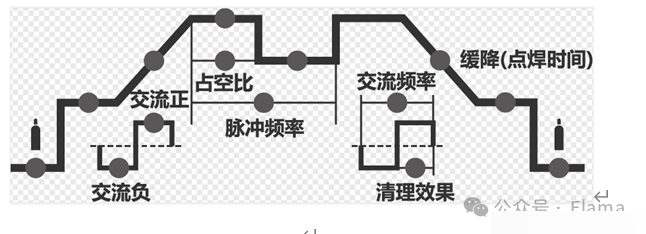
When welding aluminum plates with TIG, alternating current (AC) is used. Direct current reverse polarity (DCEP) is rarely used: although it provides good cathodic cleaning, the tungsten electrode is subjected to high temperatures and is easily damaged. Direct current straight polarity (DCEN) protects the tungsten electrode, but offers no cathodic cleaning effect; moreover, since aluminum plates have a low melting point, they cannot withstand high temperatures and are prone to burn-through. With AC welding, the polarity alternates between straight and reverse for each half-cycle, combining cathodic cleaning with protection of the tungsten electrode. In practice, therefore, TIG welding of aluminum is always performed with AC. In addition, TIG welding of aluminum is mainly used for thin plates (thickness less than 6 mm) and for root passes on thick plates.
MIG welding of aluminum plates uses direct current reverse polarity (DCEP). Unlike TIG, the filler wire, which serves as the electrode, must melt during welding to form the weld metal; high temperature favors wire melting, and since the aluminum plate is connected to the negative terminal, the cathodic cleaning effect is good. In fact, all gas metal arc welding processes (CO₂, MAG, and MIG) use DC reverse polarity.
Advantages and Disadvantages of Pulsed MIG Welding of Aluminum
Advantages of MIG welding of aluminum: low process cost, flexible operation, and wide applicability. The arc burns stably, droplet transfer to the weld pool is smooth, and the weld bead is uniform and aesthetically pleasing. Heat input and welding distortion are small, high-speed automated welding is possible, and production efficiency is high.
Disadvantages of MIG welding of aluminum: extremely strict requirements for surface cleaning of the base material, and poor wind resistance, making it unsuitable for outdoor/field welding.
Advantages and Disadvantages of AC TIG Welding of Aluminum
Advantages of AC TIG welding of aluminum:
- Flexible and convenient operation, little slag, and no post-weld cleaning required;
- Low-current welding is possible, making it easy to weld thin plates below 6 mm;
- The cathodic cleaning action helps break up the oxide film on the aluminum alloy surface.
Disadvantages of AC TIG welding of aluminum:
- Slow welding speed results in relatively high heat input, causing greater distortion and residual stress in the aluminum alloy after welding;
- The joint softens considerably, making the process unsuitable for large, thick workpieces;
- Low metal deposition rate, and hand–eye coordination is difficult to master, requiring extensive practice.
Selection Recommendations
For thin plate welding (below 6 mm) where high weld quality or high welding flexibility is required, TIG welding is the better choice.
For medium and thick plate welding (below 50 mm) where high efficiency and low cost are required, MIG welding is more suitable.
Conclusion
Aluminum and aluminum alloys occupy an important position among the various materials used in modern engineering. Their annual world production ranks second only to steel, and first among non-ferrous metals. Aluminum alloys first made their mark in the aviation industry; in recent decades, besides aviation, they have been widely used in aerospace, automotive, shipbuilding, bridge construction, machinery manufacturing, electrical engineering, the chemical industry, and low-temperature equipment, for manufacturing various components, fuel tanks, corrosion-resistant containers, and conductors. At present, the most widely used aluminum alloys in welded structures are the anti-rust aluminum alloys, namely aluminum-magnesium alloys and aluminum-manganese alloys.