
AC-DC TIG Welding Processes for Aluminum
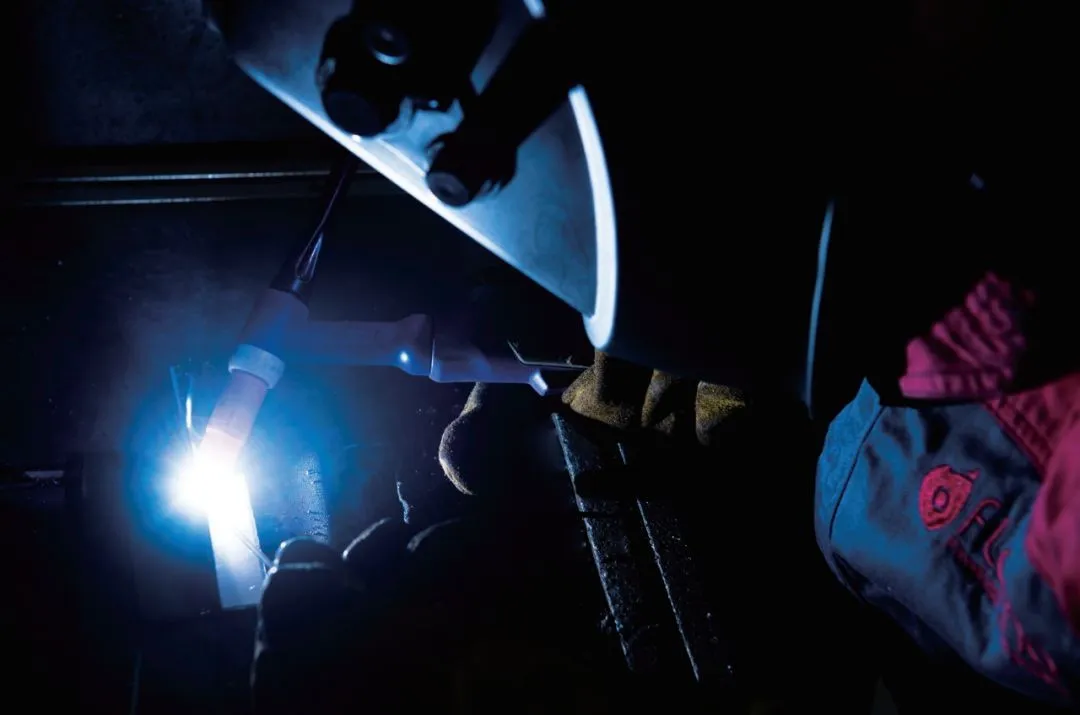
At the skin seams of the C919 large passenger aircraft, at the critical joints of new-energy vehicle battery trays, and in the precision fabrication of spacecraft fuel tanks, a cluster of azure arc light always dances across aluminum surfaces. This tungsten inert gas (TIG) arc — often likened to a “metal embroidery needle” — is tackling the long-standing challenges of aluminum alloy welding through alternating-current/direct-current (AC/DC) switching. As a manufacturer of welding power source technology, we present the key process points of AC/DC TIG welding for aluminum alloys.
The Challenge of Aluminum Alloy Welding: Why Choose AC/DC TIG?
1.1 Inherent Challenges of Aluminum Alloys
- The oxide film problem: the huge melting point gap between the dense 4 nm Al₂O₃ oxide film (melting point 2050°C) and the base metal (melting point 660°C)
- The heat conduction challenge: the thermal conductivity of aluminum alloys is three times that of steel, so conventional welding tends to produce lack-of-fusion defects
- The hydrogen embrittlement risk: liquid aluminum absorbs hydrogen at 20 times the rate of solid aluminum, giving it extremely high porosity sensitivity
1.2 How AC/DC TIG Addresses the Problem
- AC mode (AC-TIG):
- Cathodic cleaning effect: during the negative half-cycle, electron flow bombards the oxide film, efficiently removing it
- Self-cleaning action: at a 60 Hz AC frequency, 120 surface-cleaning cycles occur per second
- DC mode (DC-TIG):
- DCEN (direct current electrode negative): 70% of the heat is concentrated in the workpiece, suitable for deep-penetration welding of plates thicker than 3 mm
- DCEP (direct current electrode positive): enhanced cleaning action, but requires special tungsten electrode materials
Detailed AC/DC Aluminum Welding Process Parameters
2.1 Waveform Control Technology
- Square-wave AC technology:
- Adjustable balance ratio (negative half-cycle ratio of 30%–70%), balancing cleaning action and penetration control
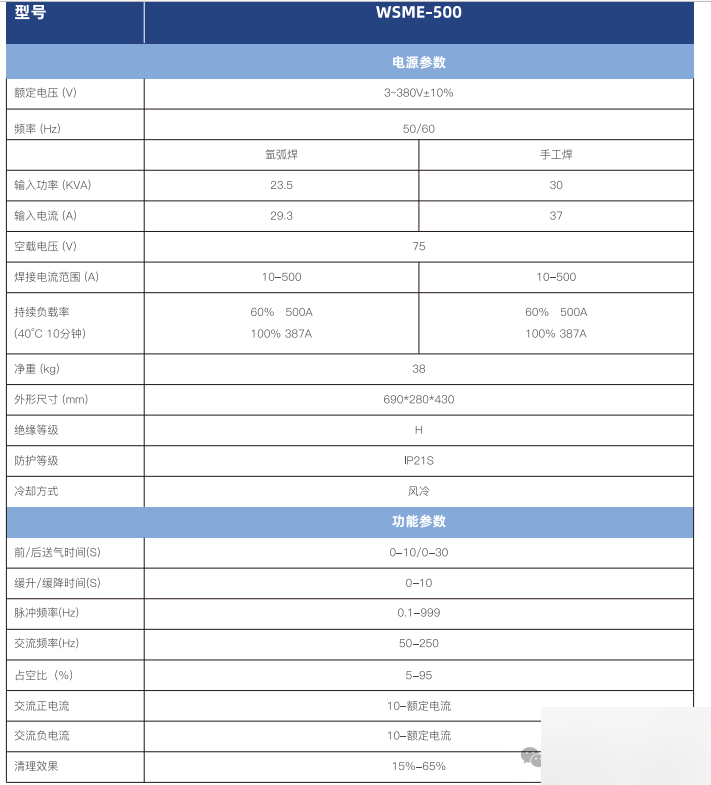
- Extended frequency range (50–250 Hz): high frequency refines the grain structure; low frequency increases weld pool fluidity
- Hybrid pulse technology:
- Background current maintains arc stability, while peak current achieves penetration
- Case study of welding an aircraft-grade aluminum plate: welding distortion of a 0.8 mm thin plate reduced by 60%
2.2 Shielding Gas Application
- Dual-cycle gas supply system:
- Pre-flow of 0–10 s and post-flow of 0–30 s prevent oxidation during arc initiation and arc termination
- Argon purity requirement: ≥99.999% (dew point below -50°C)
- Special gas mixtures:
- Ar + 30% He mixture: raises the arc temperature by 200°C and increases penetration by 40%
- Ar + 2% H₂: suitable for 5xxx-series aluminum alloys, reducing porosity by up to 80%
Technological Upgrades in Modern Power Sources
3.1 Digital Inverter Core
- IGBT inverter technology: response speed of 0.02 ms enables precise current ramp control
- Expert database system: pre-programmed process parameter packages for 32 aluminum alloys, including 6061 and 7075
- Arc characteristic analysis: real-time monitoring of arc impedance with automatic compensation for long-cable voltage drop
3.2 Human-Machine Collaborative Applications
- Cold Arc technology:
- Reduces heat input by 30%, enabling welding of 0.5 mm ultra-thin aluminum foil
- Dual-machine synchronized welding:
- Two welding machines operating in synchronization solve the start-to-end quality variation of 6 m long welds
Conclusion
From the aluminum alloy frames of Shenzhou spacecraft to the pressure hulls of deep-sea submersibles, AC/DC TIG welding technology is continuously raising the standard of aluminum joining. As a welding equipment manufacturer with core power source technology, we continue to develop key technologies such as high-frequency inverter and intelligent waveform control, and have provided aluminum welding solutions for numerous enterprises. We will keep advancing our technology to deliver reliable aluminum welding support to more high-end manufacturing sectors.